You bolt awake around four in the morning to a violent tremor in your chest: your pulse hammers against your ribs, the bedsheets are damp with cold perspiration, and the auditory echo of a collapsing wall or a bottomless drop still rings in your ears. Outside, the world is draped in tranquil silence. There is no intruder, no fire, no physical threat in the room. Yet your body is coiled and trembling as if you had just barely survived a catastrophic car crash. Why does the psychological stress we pride ourselves on managing so stoically by daylight ambush us in the vulnerable darkness of the bedroom?
In clinical dream psychology, recurrent stress dreams are among the most frequent complaints presented by high-functioning professionals. The sentiment is strikingly consistent: “During the day, I maintain total composure, resolve workplace emergencies, and hold everything together. But the moment I close my eyes, my mind becomes a torture chamber. My dreams leave me more exhausted than a twelve-hour workday.” Sufferers begin to dread bedtime, self-medicate with high doses of sedatives, and tumble into an exhausting vicious cycle: daytime tension spawns nocturnal nightmares, while nocturnal panic amplifies daytime cognitive burnout.
To demystify these unsettling nocturnal episodes, we must examine the physiological architecture of nighttime anxiety through the lens of evidence-based medicine, decode what these alarming narratives actually convey, and outline how to reclaim restorative, restorative sleep.
The Paradox of Nocturnal Anxiety: Why the Brain Storms in a Silent Bedroom
The foundational insight for anyone waking in cold dread is reassuring: an anxiety dream is neither an incurable brain dysfunction nor an indicator of psychiatric pathology. It is an emergency pressure-relief valve operating within an overloaded psychic architecture.
Throughout waking hours, our conscious mind is shielded by an array of psychological defense mechanisms. We suppress irritation during grueling meetings, compartmentalize fears of missing critical deadlines, ignore somatic fatigue, and dismiss emotional injuries with a resolute “keep pushing forward.” Yet an emotion is never merely an abstract thought; it is an embodied cascade of circulating hormones, vascular constriction, and neuromuscular microspasms. Denied expression during wakefulness, this massive somatic payload migrates into the night.
When you cross into slumber, the prefrontal cortex—the rational director and executive censor—drastically dials down its metabolic activity. The limbic system, the ancient emotional engine of the brain, surges forward unconstrained. Its evolutionary directive is to process and integrate the day’s unresolved emotional baggage. However, when waking stress levels reach saturation, that natural computational clearinghouse escalates into an unmanageable tempest.
A nightmare is not an external hostility. It is an urgent emotional dispatch from your subconscious mind, speaking through visceral metaphors to demand attention for what you dismiss during waking hours.
Neurobiology of Nighttime Stress: Cortisol, Noradrenaline, and REM Sleep
To eliminate fear of our own dreams, we must view nocturnal phenomena through the objective lens of modern neurobiology and somnology.
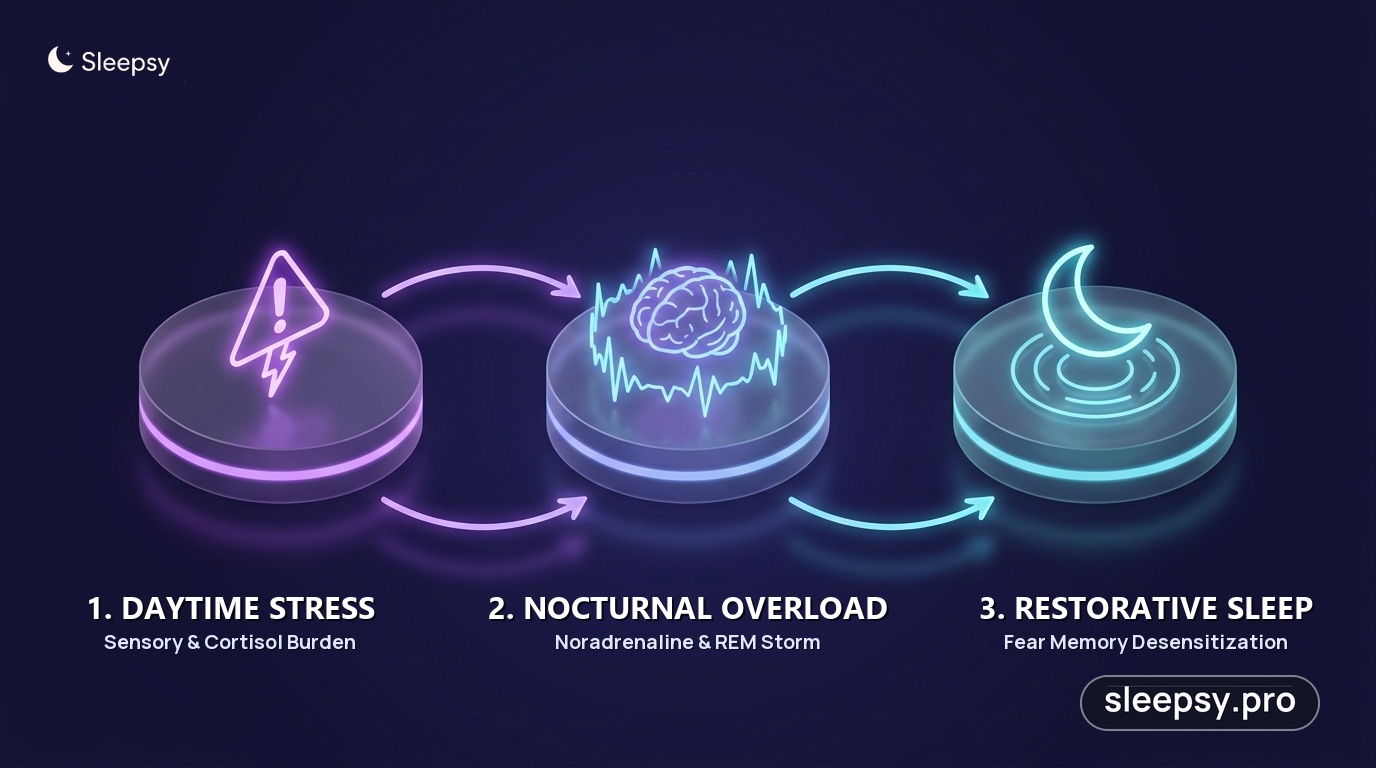
Our vivid dream narratives are generated predominantly during Rapid Eye Movement (REM) sleep. Under healthy baseline conditions, evolution endowed REM sleep with a profound nocturnal psychotherapeutic function. As demonstrated in the seminal Affect Network Dysfunction model developed by Dr. Tore Nielsen and Ross Levin at the Montreal Center for Advanced Research in Sleep Medicine, published in Sleep Medicine Reviews, dreaming serves to integrate distressing daytime experiences into broader, neutral memory networks, systematically desensitizing acute emotional fear.
In restorative sleep during REM phases, the brain’s concentration of the central stress neurotransmitter noradrenaline drops almost to zero. This is the only window in the twenty-four-hour cycle when the brain can replay and reorganize anxiety-laden events within a chemically tranquil environment: free from tachycardia, vasoconstriction, and panic. By dawn, the affective charge of memory has been neutralized—the brain’s organic mechanism for emotional scar tissue repair.
What happens, then, under chronic daytime distress?
- Endocrine Saturation: Sustained hypercortisolemia prevents the adrenal glands from tapering catecholamine production in the evening.
- REM Sleep Fragmentation: In empirical research conducted by Dr. Laura Greif and colleagues, published in Neurobiology of Stress, excess noradrenaline was demonstrated to severely fragment rapid-eye-movement sleep. The amygdala (the primal fear sentinel) remains hyper-aroused, while natural inhibitory neural pathways fail to engage.
- Visceral Somatic Entrainment: Neuroimaging investigations of heartbeat-evoked potentials (HEPs) led by Dr. Lampros Perogamvros at the University of Geneva, published in NeuroImage: Clinical, revealed that during severe nightmares, the body responds to dream events as immediate physical perils: heart rate spikes precipitously, respiratory rhythms collapse, and the sleeper is propelled into wakefulness at the zenith of adrenergic terror.
Rather than dissolving daytime tension, the neurocognitive system becomes trapped in a self-reinforcing loop of hyperarousal. The nightmare is terminated prematurely by awakening, the emotional narrative remains unintegrated, and fear conditioning is reinforced.
Deciphering the Metaphors: Falls, Catastrophes, and Paralyzing Traps
Superstitious dream encyclopedias present arbitrary prophecies, asserting that dreaming of a train derailment foretells financial misfortune on Thursday. Scientific psychology approaches dream symbolism from the opposite pole. In REM states, cognitive processing abandons verbal syntax in favor of kinesthetic, spatial, and visual metaphors. A stress dream’s plotline mirrors precisely how your nervous system experiences waking pressure at a bodily level.
Here are four ubiquitous anxiety dream archetypes and their clinical psychological decipherment:
- Free-Falling or Collapsing Bridges: The somatic experience of losing psychological footing and autonomy. These scenarios frequently manifest when foundational life pillars—career security, contractual trust, or economic stability—develop systemic fractures.
- Relentless Pursuit with Immobile Limbs (Lead Legs): An unconscious representation of severe procrastination or an unaddressed interpersonal conflict. The pursuer is rarely a malicious adversary; it represents an evaded obligation, disowned guilt, or fear of accountability.
- Loss of Voice or Inability to Dial Emergency Services: The visceral sensation of being silenced, dismissed, or unable to express legitimate anger and boundary violations in family or organizational dynamics.
- Structural Destruction: Cracking Walls, Flooding Ceilings: In psychoanalytic and somatosensory theory, architecture represents the self—the physical body and psychological ego boundaries. Crumbling domestic walls signal critical psychosomatic depletion: internal energetic resources are spent, and personal boundaries have been breached (a somatic parallel to the emotional boundaries explored in our analysis of water in dreams and the expansive autonomy found in flying dreams).
If you want to discover what your subconscious mind is communicating through nocturnal imagery, complete our Sleepsy Psychological Dream Assessment—an intelligent evaluation pairing your dream narratives with your waking emotional landscape.
Clinical Case Study: When Cracking Structures Saved an Engineer
The client’s name and identifying details have been anonymized; dream narratives and analytical findings are published with explicit client consent.
Consider a revealing case from sleep psychology practice: Vadim, a 44-year-old lead structural engineer directing a strategic municipal bridge construction project at a renowned engineering firm. A tall, disciplined professional with fatigued eyes behind wire-rimmed glasses, he possessed a subconscious habit of clenching his jaw whenever discussing project milestones.

“I am directing the construction of a critical multi-span suspension bridge scheduled for delivery in sixty days. I carry personal legal liability for every millimeter of structural calculations. Outwardly, I present absolute calm: my staff sees no hesitation, and the executive board commends my management. But for the past three weeks, I have lived as an insomniac ghost. Promptly at 3:45 AM, I bolt awake with a thudding heart from the exact same nightmare. I am perched on the uppermost pylon of the bridge under construction. The reinforced concrete beams fracture with webs of hairline cracks, and the steel girders screech, buckling beneath my boots. I throw myself onto the multi-ton crossbeam, trying to hold the structure together with my bare hands, peeling skin down to raw muscle. I scream down to the crane operator, but only a dry, rasping wheeze emerges. The bridge shears apart, plunging into a freezing black river and pulling me under. I awaken soaked in ice-cold sweat, unable to sleep until sunrise. Yesterday on site, I caught myself checking a basic shear formula three times, unable to recall elementary load equations...”
An exploratory clinical evaluation unmasked Vadim’s waking reality. Beneath his flawless professional facade lay profound isolation and perfectionism. He refused to delegate to junior engineers, re-verified calculations until midnight, answered site calls throughout weekends, and operated on the cognitive assumption: “If I release oversight of a single bolt, catastrophe is guaranteed.”
The collapsing bridge in his nightmare had nothing to do with civil engineering flaws. It was a precise kinesthetic translation of his autonomic nervous system. The brain, utilizing his familiar professional lexicon, was shouting: “Your internal scaffold is overloaded! Your neurological load-bearing capacity has failed, and you are trying to carry the mass of an entire team alone.”
A structured three-week clinical intervention was deployed:
- The 2-Hour Pre-Sleep “Oversight Boundary”: Vadim instituted an operational briefing at 6:30 PM, transferring active shift responsibility to the designated field engineer. At 8:00 PM, his project smartphone was placed in airplane mode in the foyer.
- Image Rehearsal Therapy (IRT): In session, we restructured the nightmare’s trajectory. In the revised scenario, when the girder vibrated, Vadim did not grasp it. He stepped back onto an anchored service catwalk, engaged the emergency hydraulic stabilization protocol, and watched automated cranes secure the span while a seasoned rigging crew locked safety cables. The bridge held firm. Vadim mentally rehearsed this stable script every evening before sleep (a discipline complemented by keeping systematic logs, as detailed in how to keep a dream journal).
- Somatic Jaw and Trapezius Release: Somatic assessment showed Vadim unconsciously clenched his jaw to the point of enamel wear. Progressive muscle relaxation (Jacobson technique) and 4-7-8 diaphragmatic breathing were instituted to release this muscular armor prior to bed.
By day ten, the catastrophic collapse narrative ceased. He experienced a dream of the bridge illuminated in dawn light, carrying steady traffic. By the conclusion of the third week, nocturnal arousals had fully resolved, daytime mental acuity returned, and psychometric anxiety scores decreased by more than 50%.
4 Steps to Restful Silence: An Evidence-Based Sleep Reset Protocol
If disturbing dreams compromise your nights, do not wait for exhaustion to culminate in chronic depression or cardiovascular crisis. Here is an evidence-based clinical protocol you can initiate tonight.

- “Cognitive Worry Parking” 90 Minutes Before Bed: Take physical paper and write down every unresolved dilemma, operational anxiety, and tomorrow’s task list. Human neurobiology operates such that until a worry is offloaded onto external media, the prefrontal cortex will cycle through it endlessly, fueling nocturnal alarm centers. Having transcribed the item, tell yourself: “This is cataloged; I will confront it tomorrow at 9:00 AM.”
- Digital Photic Hygiene: Blue spectrum radiation emitted by smartphone displays suppresses melatonin synthesis and maintains autonomic arousal. Scrolling news or work communications before sleep provides direct passage into nightmare territory. Replace screens with an Epsom salt bath or physical reading under warm incandescent illumination.
- Image Rehearsal Therapy (IRT): If a recurring dream torments you, do not attempt to suppress it. During daylight, transcribe the nightmare in rich detail, then deliberately construct a safe, triumphant, or humorous conclusion. A comprehensive systematic review by Dr. Valentina Baldini in Sleep Medicine Reviews indicates that daily mental rehearsal of a revised ending resolves chronic nightmares in over 70% of clinical cases.
- Vagal 4-7-8 Breathing Rhythm: Inhale quietly through the nose for 4 counts, hold for 7 counts, and exhale completely through the mouth for 8 counts. This rhythmic pattern mechanically stimulates the vagus nerve (nervus vagus), lowers heart rate, and shifts autonomic tone from sympathetic fight-or-flight into parasympathetic rest-and-digest.
Remember: restful sleep is not an elusive luxury or an accident of chance; it is a fundamental biological requirement of your nervous system.
Key Takeaways
Here are the essential clinical principles for regaining mastery over your nocturnal rest:
- Nightmares Are Allies, Not Adversaries: Anxiety dreams function as sensitive diagnostic indicators of daytime emotional saturation and suppressed distress.
- Neurochemical Equilibrium: Chronic stress disrupts the organic architecture of REM sleep, preventing noradrenaline from dropping to baseline restorative levels.
- Symbols Mirror Somatic Limits: Dreams of falling, pursuit, or collapse reflect the physiological limits of hyper-control and unexpressed vulnerability.
- Waking Habits Dictate Nighttime Peace: Offloading cognitive working memory, rewriting nightmare scripts with IRT, and engaging vagal breathing reliably dismantle the cycle of nocturnal panic.
The Core Principle: If your nights have turned into a psychological battlefield, cease warring against your dreams. Listen to their structural warnings, lighten your waking burdens, and allow nighttime to reclaim its rightful role as your sanctuary of renewal.
To master restorative sleep rituals, explore guided somatocognitive soundscapes, and consult clinical sleep specialists, unlock full access to the Sleepsy platform. Give your nervous system the profound tranquility it deserves.