
Almost everyone remembers the exhilarating sensation: a single effortless push off the ground, and suddenly gravity surrenders. The earth drops smoothly away beneath your feet, rooftops shrink into miniature grids, and your chest floods with an intoxicating surge of weightlessness and unconditional liberation.
Dreams of flying rank among the most intensely vivid phenomena in human psychology. People often wake from them feeling invigorated, yet quietly perplexed: “I was soaring through the clouds last night with total confidence. Why do I feel so grounded, exhausted, and hesitant the moment my feet hit the floor?”
From Folklore to Freud: Why Dream Dictionaries Miss the Mark
The instinctive reaction after waking from a flying dream is often to consult a traditional dream dictionary. Yet cross-referencing popular sources quickly reveals a maze of outright contradictions:
- Gustavus Hindman Miller: Tended to frame flight around social status and material fortune. Soaring high into the ether promised professional triumphs or romantic partnerships; skimming precariously above treetops warned of domestic troubles; plummeting downward portended catastrophic ruin.
- Psychoanalytic Tradition (Sigmund Freud): Reduced nocturnal levitation to repressed instinctual drives, ambivalence toward parental authority, and an unconscious struggle between craving independence and fearing total loss of control.
- Carl Jung and Analytical Psychology: Interpreted flight as a compensatory archetypal motif. When conscious life becomes overly rigid or earthbound, the unconscious compensates by elevating the psyche into the sky, warning against hubris while encouraging broader perspective.
- David Loff: Emphasized that universal templates do not exist. Flight reflects a psychological attempt to compensate for feelings of powerlessness and restricted autonomy in waking reality.
The contradiction is obvious: if one authority promises windfall wealth, another warns of inevitable downfall, and a third diagnoses hidden anxiety, which one are you supposed to believe?
Traditional dream dictionaries fail because they attempt to superimpose static, one-size-fits-all prophecies onto dynamic, living human minds. Interpreting nocturnal flight in isolation from your waking life is meaningless: a dream is never an oracle forecasting tomorrow, but an intimate neurobiological mirror reflecting the state of your nervous system right now.
The Neuroscience of Flight: Vestibular Signaling and REM Atonia
Modern somnology and cognitive neuroscience demonstrate that nocturnal weightlessness is neither supernatural nor random. It arises from an elegant physiological paradox occurring during Rapid Eye Movement (REM) sleep.
During REM sleep, the brain enters a state known as muscle atonia. Brainstem motor neurons release inhibitory neurotransmitters (glycine and GABA) that effectively paralyze voluntary skeletal muscles, preventing you from physically acting out your dreams in bed. Crucially, however, the vestibular nuclei in the brainstem—responsible for sensing equilibrium, orientation, and spatial acceleration—remain active and responsive.
When the motor cortex dispatches neural impulses to move, run, or jump, but peripheral sensory receptors register zero physical resistance and no tactile pressure against the soles of your feet, the dreaming brain reconciles this discrepancy through synthesis: it interprets the absence of gravity as frictionless, weightless flight.
Peer-reviewed sleep research confirms this close sensorimotor loop:
- Vestibular Sensitivity and Lucid Agency: In a landmark study published in the journal Sleep (2022) led by Dr. Claudia Picard-Deland, researchers demonstrated that individuals who frequently experience flight dreams and lucid awareness display significantly sharper vestibular balance and heightened internal senses of bodily self-agency. Our internal biological gyroscope remains remarkably engaged through the night.
- Neuroplastic Dream Incorporation: In a controlled experiment published in Consciousness and Cognition (2020), participants who experienced a virtual reality zero-gravity simulation prior to sleep exhibited an immediate surge in flying-themed dreams that very night. The brain actively assimilated novel vestibular and spatial sensations into its nocturnal storytelling engine.
Neuroscience Insight: Nocturnal flight is not magic; it is an exquisite neurobiological dialogue. During REM sleep, the cerebral cortex translates subtle vestibular signals and muscle atonia into powerful psychological metaphors of emotional release, personal transcendence, or escape.
Clinical Observation: When Soaring Becomes an Escape

In clinical dream analysis, recurrent nocturnal flight often presents a paradoxical picture. Consider a common profile: a 32-year-old engineering lead navigating high-stakes corporate restructuring while suppressing severe chronic burnout.
Night after night, she experienced an intense, recurring dream scenario:
“I launch effortlessly above the city skyline. The higher I climb, the lighter I feel. But the instant I consider descending back toward earth, the atmosphere freezes solid like impenetrable glass. I flap my arms frantically, lose altitude, and wake gasping with my heart pounding an instant before crashing onto the asphalt.”
By day, she held herself to unforgiving standards of perfectionism, forbidding vulnerability or fatigue. Her nighttime flights provided her psyche with its only functional decompression valve—a temporary realm where gravity, accountability, and the weight of relentless decisions vanished.
Frequently, the most intoxicating flying dream is not an indicator of absolute power, but a subconscious distress signal: an urgent attempt by an overburdened nervous system to flee crushing hyper-responsibility and waking entrapment.
Her dream was a textbook example of compensatory psychological escape. The subconscious revealed what the conscious ego refused to admit: while flying high in nocturnal illusions offers fleeting sanctuary, sustainable well-being requires delegating responsibility, accepting vulnerability, and building solid footing on the ground.
This is why Sleepsy rejects the superstitious assertions of archaic dream books. Authentic dream analysis evaluates real-world psychological context: baseline stress, emotional exhaustion, and current life transitions.
Dream Architecture: Why Context Outweighs the Symbol
In analytical dream psychology, no motif possesses a fixed universal definition. The meaning of flight is shaped entirely by the emotional climate of the dreamer’s waking life:
| Flight Dream Narrative | Superstitious Dream Book Claim | Contextual Psychological Analysis |
|---|---|---|
| Effortless gliding above the ground | Imminent spiritual promotion or sudden monetary windfall | For an exhausted caregiver: an unconscious flight into personal sanctuary. For someone launching an independent project: healthy emergence of self-agency. |
| Straining desperately to gain altitude | Impending financial hardship and unavoidable obstacles | Acute cognitive fatigue, impostor syndrome, or bearing obligations that exceed current psychological capacity. |
| Sudden plunge following a high ascent | Omen of grief, betrayal, or crushed hopes | Paralyzing fear of losing control when stepping toward a major life transition, revealing insufficient emotional grounding. |
4 Psychological Flight Scenarios and What They Signal
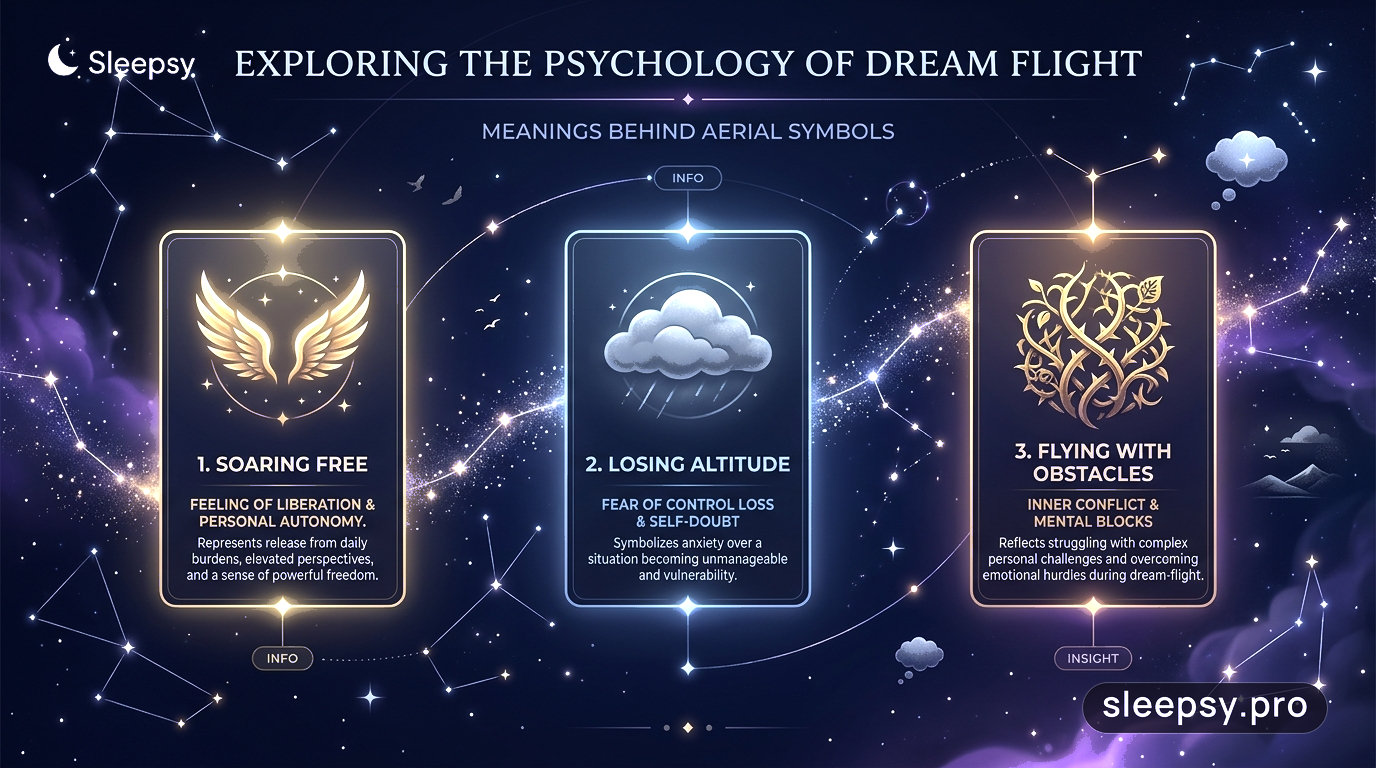
In analytical psychology, the subjective emotional tone during flight serves as the primary diagnostic key. Consider the four dominant scenarios:
- Controlled Low-to-Mid Altitude Gliding: A signature of emerging self-agency. Frequently experienced when resolving a protracted interpersonal conflict, establishing firm boundaries, or breaking free from codependency. You retain clear visual contact with the earth while moving freely above obstacles.
- Unbounded Ascent into Deep Space: A signal of psychological ungrounding. Soaring so high that the earth dissolves into a distant speck often reflects intellectualization or emotional dissociation—using detachment to numb raw pain or avoid difficult emotional encounters on earth.
- Flight as Flight (Evading Threat): Defensive avoidance. When soaring is catalyzed by escaping a pursuer or disaster, the subconscious is literally running away in the air rather than confronting a necessary waking conflict.
- Sluggish, Viscous Resistance: Cognitive and sensory overburden. Straining your muscles against thick, syrup-like air indicates feelings of being trapped by external expectations, perfectionism, or profound physical exhaustion.
Deconstructing Your Flight Dream: 3 Reflective Inquiries
If you wake up carrying the vivid impression of flight, bypass superstitious fortune-telling and pose these three grounded inquiries to yourself:
- What was the dominant emotional current during flight? Was it serene mastery, dread of the drop, or profound relief at putting distance between yourself and the earth?
- What in your waking life are you longing to rise above? Is it an exhausting interpersonal dynamic, administrative drudgery, or an internal standard of relentless perfectionism?
- How solid is your emotional footing right now? Do you feel adequately supported and anchored in your daily routines, boundaries, and relationships?
The essential therapeutic inquiry: If the altitude of your flight represented your emotional distance from life’s demands, how high are you hovering—and is it time to gently, intentionally touch down?
Key Takeaways
- Prescriptive Dictionaries vs. Reality: Dream dictionaries contradict each other because they treat dynamic neurological experiences as rigid symbols. A dream does not foretell the future; it mirrors current autonomic arousal and emotional processing.
- Neurobiology of REM Sleep: Nocturnal levitation emerges naturally when vestibular balance centers fire while skeletal muscles remain in REM atonia. High frequency of flight dreams correlates with acute vestibular sensitivity and stronger senses of self-agency.
- Context Is Paramount: Depending on waking circumstances, flight can represent either a healthy leap into authentic autonomy or a defensive escape from burnout and crushing responsibility.
Core Conclusion: When flight visits your sleep, do not search for prophecy. Ask yourself what burden you are seeking to shed, and whether your mind is inviting you to claim your autonomy—or reminding you to seek solid ground.
Dreams are the mind’s gentle, uncompromising mirrors. They do not judge; they illuminate the exact spaces where healing and balance are waiting to be reclaimed.
To cultivate a deeper relationship with your nocturnal subconscious, track recurrent patterns, and receive evidence-based analyses tailored to your waking life, explore full access to the Sleepsy platform. With your personal dream journal and empathetic AI psychological insights, every night becomes an opportunity for profound self-understanding.