
Your alarm pierces the morning silence, and for a few fleeting seconds, an astonishing nocturnal universe hovers before your eyes: a soaring flight above a shimmering coastline, an intricate labyrinth of mirrors, or an emotionally charged reunion with someone from your distant past. You reach for your phone, take a sip of water—and within thirty seconds, the entire landscape evaporates like watercolor under running water. By the time the kettle boils, all that remains is a faint emotional echo. This rapid disappearance is neither absentmindedness nor a memory defect. Our neurobiology is deliberately designed to protect conscious wakefulness from nocturnal chaos, actively wiping up to 95% of dream content before your feet ever touch the floor.
Night Architecture: How the 90-Minute Ultradian Cycle Unfolds
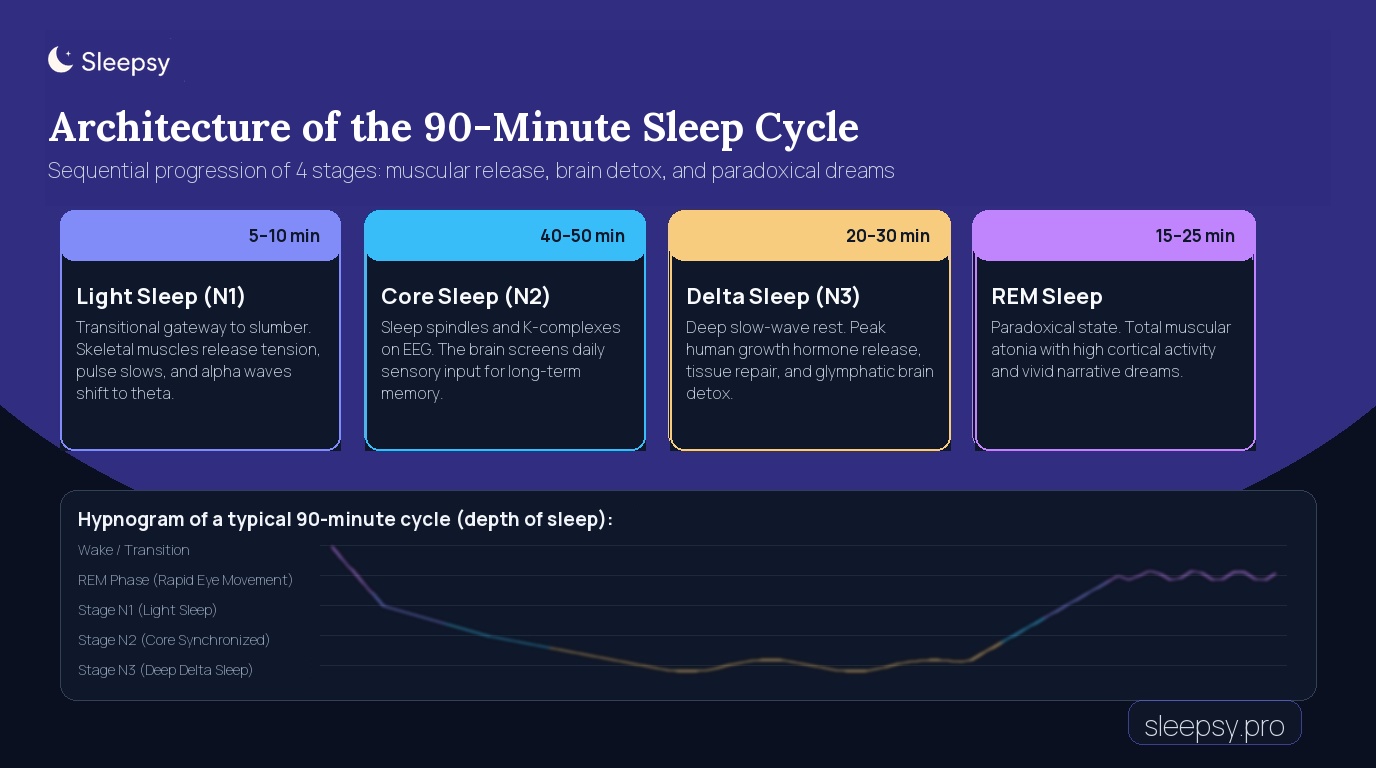
Slumber may feel like a uniform, dark pause, but for the central nervous system, it is an exquisitely choreographed biological relay. A healthy night’s rest for an adult comprises four to six continuous ultradian cycles. Each cycle lasts approximately 90 to 110 minutes, orchestrating an orderly progression through distinct neurophysiological stages: descending from light transitional sleep into profound slow-wave delta rest, and subsequently ascending toward the paradoxical phase of Rapid Eye Movement (REM) sleep.
During the first third of the night, evolutionary biology assigns absolute priority to somatic restoration: early cycles are dominated by deep Non-REM (N3) slow-wave sleep. Toward dawn, this neurochemical balance shifts dramatically. Deep delta intervals contract, while REM episodes expand progressively, reaching 30 to 45 minutes in the final cycle before waking. This nocturnal rhythm explains why our most vivid, elaborate, and emotionally gripping dreams consistently unfold during the early morning hours.
NREM vs. REM: Cellular Detoxification and the Theater of Imagery
Modern cognitive somnology divides sleep into two fundamentally distinct functional modes: Non-Rapid Eye Movement (NREM) sleep and Rapid Eye Movement (REM) sleep.
NREM sleep comprises three progressive sub-stages:
- N1 (Transitional Light Sleep): The delicate gateway between wakefulness and slumber. Skeletal muscles release tension, core body temperature begins its downward drift, and respiratory rhythms decelerate.
- N2 (Core Synchronized Sleep): Characterized on electroencephalograms (EEG) by sleep spindles and sudden K-complexes. Extensive somnological research demonstrates that sleep spindles actively orchestrate the primary sorting of daily sensory impressions, screening memory traces for long-term consolidation (Diekelmann & Born, Nature Reviews Neuroscience).
- N3 (Deep Slow-Wave Delta Sleep): The zenith of physiological regeneration. The anterior pituitary gland secretes human growth hormone for cellular tissue repair, while the brain’s glymphatic system expands, flushing cerebrospinal fluid through neural tissue to clear neurotoxic metabolic waste, including beta-amyloid plaques.
Following slow-wave rest, the brain transitions into the paradoxical state of REM sleep. The term “paradoxical” captures an extraordinary biological contradiction: while peripheral motor neurons are held in complete muscular atonia—paralyzing skeletal muscles so we do not physically enact our dreams—the cerebral cortex ignites with intense metabolic activity. Cortical neurons consume as much oxygen and glucose as during high-focus wakefulness. The limbic system and amygdala fire at peak intensity, weaving vivid metaphors where rigid daytime logic yields to pure emotional synthesis. When waking stress becomes unmanageable, this REM mechanism can fracture, generating persistent recurring dreams of entrapment or pursuit.

The Neurochemistry of Forgetting: Why the Hippocampus Shuts Down Recording
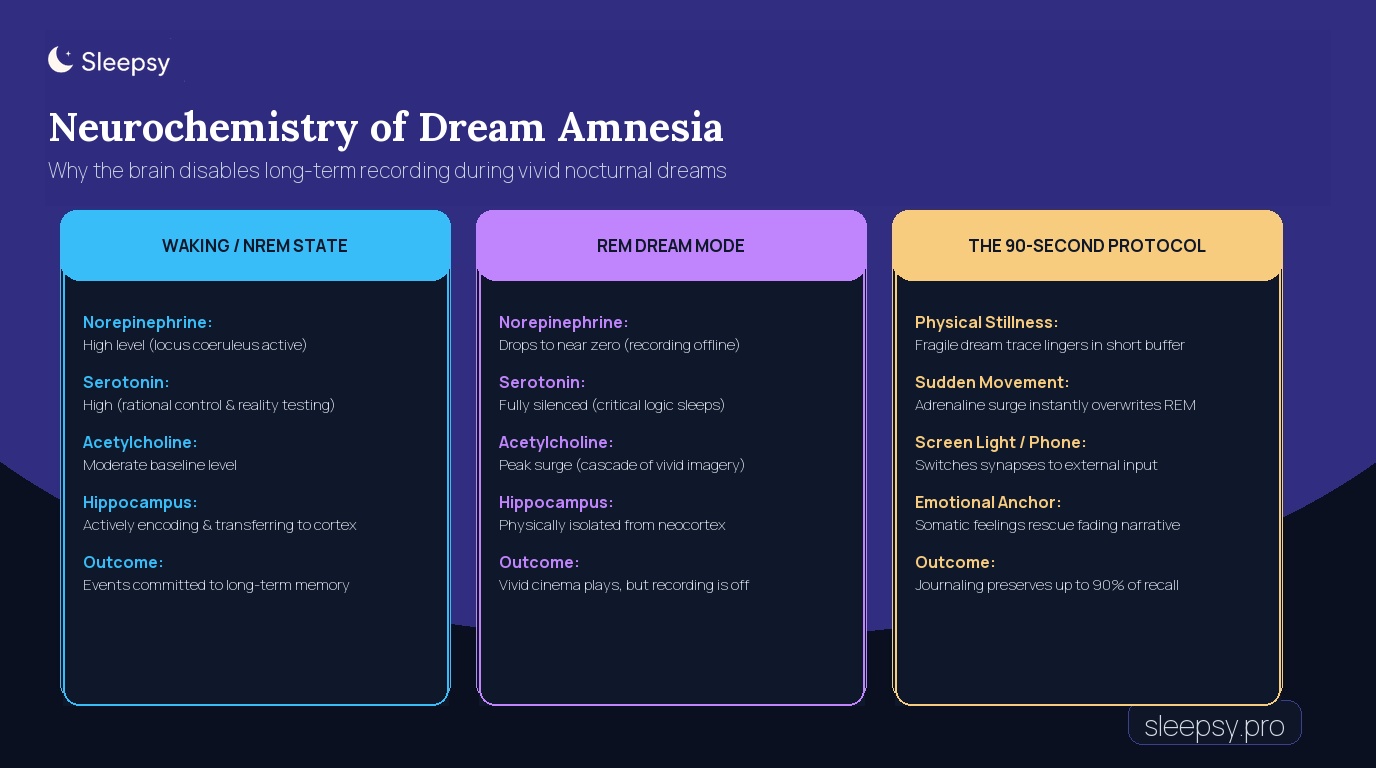
Why do such intensely real, emotionally visceral nocturnal dramas dissolve without a trace the moment we open our eyes? The answer resides within synaptic neurochemistry. For an experience to be encoded from temporary working awareness into long-term autobiographical storage, the brain requires robust concentrations of norepinephrine (noradrenaline) alongside synchronized transmission from the hippocampus to the neocortex.
During REM sleep, an extraordinary biochemical switch flips: the locus coeruleus shuts down its release of norepinephrine and serotonin almost completely, while acetylcholine surges to unprecedented levels. Devoid of norepinephrine, the hippocampus is functionally decoupled from long-term memory encoding centers. The dreaming brain is watching a cinematic masterpiece in its internal theater, but the hardware recording mechanism has been deliberately switched off.
Neurobiologists emphasize that dream amnesia represents a vital evolutionary adaptation for predictive homeostasis (Simor et al., Neuroscience & Biobehavioral Reviews, 2023). If the human brain committed bizarre, surreal nighttime simulations to permanent storage with the same fidelity as waking reality, conscious awareness would swiftly lose the ability to distinguish actual physical events from nocturnal hallucinations.
“I Never Dream”: A Scientific Perspective on Nocturnal Recall
The assertion “I simply never dream” is remarkably common, yet sleep laboratory polysomnography dispels it decisively. When participants who claimed a lifetime absence of dreams were monitored with EEG electrodes and awakened during REM cycles, over 80% immediately recounted vivid, intricate, and emotionally nuanced narratives.
The distinction between individuals who remember dreams daily and those who awaken to a blank slate stems from cortical arousal patterns and brief nocturnal micro-awakenings. In clinical research conducted at the University of Rome, neuroscientists revealed that the ability to retrieve morning dream memories correlates directly with delta wave oscillations in the frontal and temporoparietal regions during transitions to wakefulness (Scarpelli et al., Brain Topography, 2017). Light sleepers experience brief, half-second micro-arousals between cycles, granting the hippocampus a fleeting window to transfer fragments of REM imagery into conscious awareness before the memory trace dissipates.
The 90-Second Rule: How to Capture Fleeting Morning Dreams
To establish a meaningful dialogue with your subconscious and capture the psychological wisdom of your nights, you do not need complex rituals. You simply need to align with your brain’s physiology. The memory trace of a dream lingers in a fragile, short-term neurochemical buffer for roughly 90 to 120 seconds after waking. Here is the evidence-based clinical sequence to preserve it:
- Maintain Absolute Physical Stillness: The instant you become aware of waking, do not open your eyes abruptly, do not check your smartphone, and do not shift your physical posture. Sudden somatic movement or blue-spectrum screen light floods the sensory cortex, triggering an immediate surge of waking neurotransmitters that instantly overwrites delicate REM traces.
- Anchor into Visceral Emotion First: Before trying to reconstruct the plotline, ask yourself: “What feeling is resonating in my body right now?” Is it lightness, relief, melancholy, anxiety, or wonder? Somatic emotional traces fade far more slowly than visual narratives, serving as a reliable lifeline back to the dream’s core scenario.
- Rewind the Narrative in Reverse: Holding onto that emotional thread or the last visual snapshot, gently ask: “What happened an instant before this? Where was I positioned? Who was speaking?” Dream memories naturally unfurl from the final scene backward to the beginning.
- Transcribe Three Key Markers: Keep a dedicated notebook within arm’s reach on your nightstand. As explored in our detailed guide on how to keep a dream journal, writing three brief anchors—space, anomaly, and emotion—trains neural retrieval pathways so your mind stops discarding dreams as irrelevant noise.
Key Takeaways
- Sleep Architecture Is Cyclic: Human sleep consists of 4 to 6 recurring 90-minute ultradian cycles, transitioning from deep somatic recovery in early hours to expansive emotional REM processing at dawn.
- Everyone Dreams: Laboratory polysomnography proves that dream generation is universal; differences in recall stem from brief micro-awakenings and cortical arousal rhythms.
- Dream Amnesia Is Protective: The depletion of norepinephrine during REM sleep decouples the hippocampus, shielding conscious waking life from confusion with surreal nocturnal hallucinations.
- Stillness Preserves Recall: Honoring the 90-second rule of physical stillness upon waking reliably bridges the fragile gap between sleeping awareness and waking memory.
Core Conclusion: Your dreams do not dissolve because your memory is faulty; they fade because your brain is honoring its duty to protect your waking day. By learning to inhabit the first ninety seconds of morning stillness, you unlock a profound, lifelong archive of personal insight.
To cultivate a deeper relationship with your nocturnal mind and effortlessly track your sleep architecture, explore full access to the Sleepsy platform. With an intelligent dream journal and empathetic AI insights, you can turn fleeting morning impressions into lasting personal clarity.