Your alarm sounds, leaving the metallic taste of nocturnal helplessness lingering in your throat: again that suffocating corridor, those endless crumbling stairs, or the painfully familiar locked door that refuses to budge. A recurrent dream scenario is rarely random. The sleeping brain is not generating arbitrary screensavers: when a waking emotional knot is drawn too tight, the nocturnal processing system loops the identical reel, demanding resolution.
The Broken Record: Why the Brain Loops the Same Scenario
During Rapid Eye Movement (REM) sleep, our subconscious reorganizes the day’s emotional archive. It categorizes experiences, attenuates raw affective charges, and integrates memories into broader cognitive networks. But when waking life presents an intractable internal conflict, this calibrated processing conveyor belt stalls.
If we consistently suppress dread, shame, or resentment during waking hours, the psyche cannot neutralize the emotional payload within a single sleep cycle. Seminal empirical somnological investigations led by Dr. Antonio Zadra at the Université de Montréal demonstrate that the frequency of recurrent dreams directly mirrors the severity of chronic psychological distress (Zadra et al., Dreaming). A recurrent dream functions like a persistent certified delivery notice: until the recipient breaks the seal and addresses the contents, the system will deliver reminders again and again.
Contemporary neurobiological research corroborates this repetition principle in stress-related dream imagery (Avci, Scientific Reports, 2025). The subconscious deploys a well-rehearsed metaphor as an emergency pressure valve. The narrative loop will continue to recur until an individual modifies either their waking behavior or their internal relationship with the underlying conflict.
Three Archetypal Scenarios: What the Subconscious Is Signalling
While the external set pieces of a dream are intensely personal, the psychological dynamics beneath them are strikingly universal. In clinical dream psychology, three core archetypes recur with notable consistency:
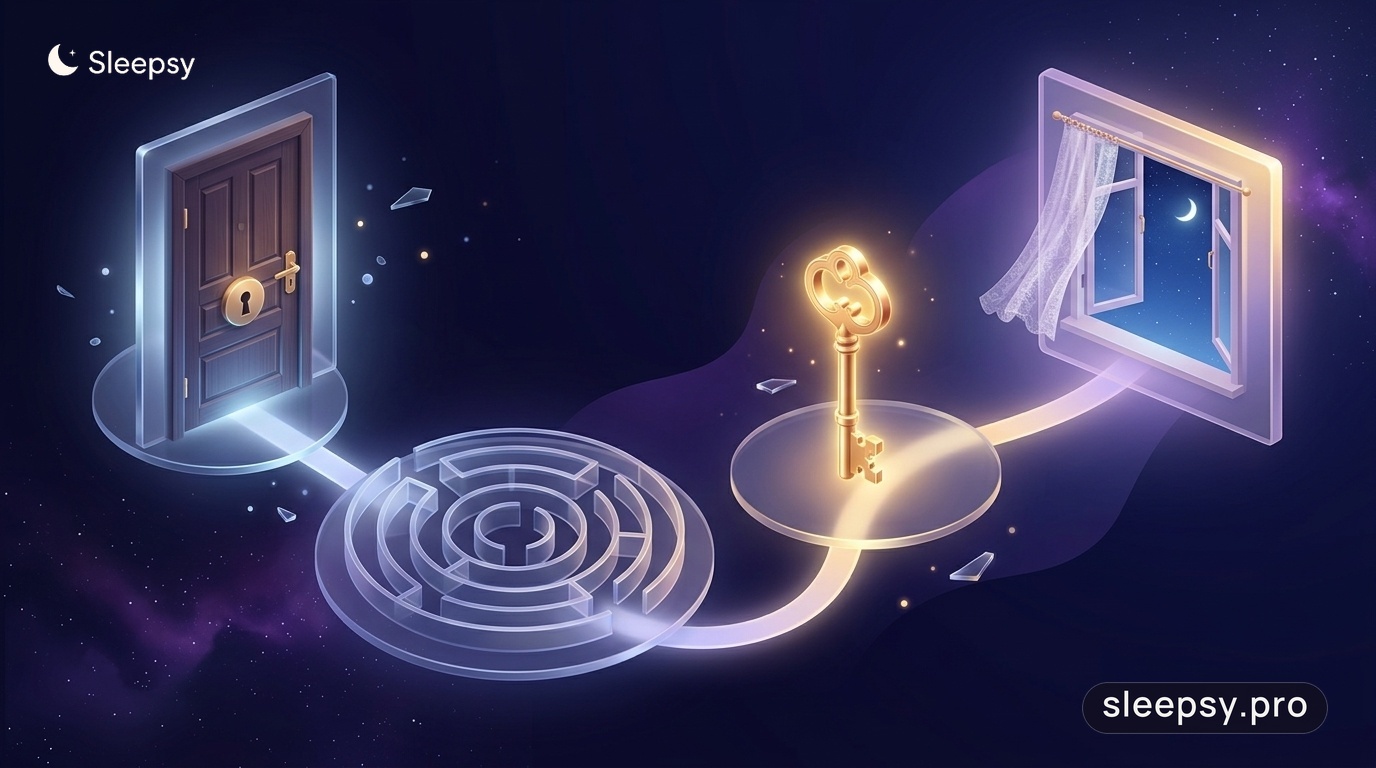
- Trapped in an Elevator, Locked Room, or Infinite Labyrinth: The visceral signature of existential stagnation. An individual has outgrown a professional post or an exhausted relationship, yet feels paralyzed by fear of stepping into the unknown. The brain constructs physical confinement where the waking ego has painted itself into a corner.
- Relentless Pursuit with Lead Limbs: Legs feel heavy as lead, running is agonizingly slow, and the shadowy threat closes in. This is an embodied metaphor for daytime avoidance. The dream broadcasts a dilemma from which the sleeper actively retreats: a brewing divorce, overwhelming financial debt, conflict with executive leadership, or unacknowledged somatic burnout. The more persistently an issue is denied by daylight, the closer the pursuer draws by night.
- Unprepared Examination or Loss of Voice Before an Audience: A poignant manifestation of imposter syndrome and perfectionism. The sleeper agonizes over the irrational fear of being exposed as fraudulent or inadequate. Nocturnal muteness signals that an individual habitually swallows legitimate grievances and forbids themselves from asserting healthy personal boundaries.
When distressing scenarios disrupt your sleep week after week, exploring how anxiety dreams and stress exhaust the autonomic nervous system clarifies why unrestful nights compound daytime cognitive burnout.
The Architecture of Stagnation: The Elevator Between Floors

Consider a classic scenario from sleep psychology: an analytics team lead navigating a high-stakes organizational promotion. For over a year, a repetitive dream strikes weekly: entering a sleek glass elevator in a corporate tower, pressing the button for the executive suite, only for the cabin to shudder and screech to an abrupt halt suspended precisely between the seventh and eighth floors. The emergency call button emits no dial tone, the overhead lights flicker out, and the smartphone screen indicates zero reception.
“I stood trapped in that glass box, suffocating with dread. From below, colleagues could no longer see me; from above, executive leadership was not yet expecting me; and there was no way to summon help. Every week I would wake up exhausted with the exact same thought: I am permanently stuck.”
In dream psychology, this dynamic unmasks a classic waking dilemma: stepping away from individual contributor duties (the seventh floor) while struggling to embody authentic executive leadership (the eighth floor). The individual refused to delegate operational tasks, feared that asking for senior mentorship was an admission of inadequacy, and perceived every workflow friction as a personal failure. The suspended elevator was an exact spatial projection of hyper-responsibility.
Four Actionable Steps: How to Stop Nocturnal Repetitions

To quiet a recurring dream, one must translate symbolic dream narratives into concrete waking actions. Here is an evidence-based clinical sequence proven to break the repetitive loop:
- Focus on Somatic Emotion Rather Than Plot Minutiae: Immediately upon awakening, record the primary visceral sensation: shame, paralysis, rage, or dread. Maintaining a structured record, as detailed in our guide on how to keep a dream journal, rapidly unmasks the hidden correlation between daytime triggers and nocturnal alarm states.
- Identify Real-World Parallels: Ask yourself candidly: “Where in my waking life do I experience this identical sense of being silenced or trapped?” Dreams are rarely abstract: a jammed elevator frequently points to an exhausted initiative, while an inescapable pursuer mirrors a conversation you dread having.
- Practice Image Rehearsal Therapy (IRT): In daylight within a calm setting, mentally recall the dream up to its climax. Then deliberately author a grounded, triumphant conclusion in your imagination. For instance, visualizing yourself locating an emergency release lever, opening the cabin doors, and stepping out onto a sunlit rooftop terrace. Rehearsing this safe resolution creates alternative neural pathways that overwrite the old stress loop.
- Execute a Tangible Waking Step: Nocturnal loops dissolve when waking circumstances shift. Initiate the difficult conversation, establish firm workplace boundaries, delegate tasks, or take overdue rest. Until action is taken in reality, the subconscious will continue knocking at the door.
Key Takeaways
- Recurrent Dreams Are Urgent Signals: A repeating dream is neither a superstition nor a random malfunction; it is the brain’s persistent attempt to process unresolved emotional tension.
- Universal Metaphors Reflect Somatic Boundaries: Scenarios involving entrapment, flight, or paralysis reflect waking dilemmas of perfectionism, avoidance, and hyper-responsibility (a somatic parallel to the boundary themes explored in water in dreams).
- Resolution Serves as a Clinical Metric: Sleep laboratory research confirms that the cessation of a recurring dream serves as a reliable objective indicator that an internal psychological conflict has reached resolution.
- Dual-Action Strategy Works Best: Pairing cognitive daytime imagery rehearsal (IRT) with concrete boundary adjustments in waking life dismantles the nocturnal loop permanently.
The Core Principle: A recurring dream ceases the moment an individual stops fleeing the underlying emotion and takes a courageous, tangible step in waking reality.
To explore in-depth dream analysis, track recurring subconscious themes, and access guided somatic decompression practices, explore full access to the Sleepsy platform. Give your mind the clarity and peaceful rest it needs.