
Your morning alarm rings, a heavy sensation lingers in your chest, and a single disorienting question takes over your thoughts: “Why did I just dream about my ex?” You might not have spoken in three years. You might have zero desire to check their social media, feeling completely fulfilled in a new relationship or in peaceful solitude. Yet overnight, your brain orchestrated an intricate drama: walking hand-in-hand through an old neighborhood, arguing passionately in a familiar kitchen, or exchanging silent, searching glances in a crowded subway station.
The immediate reaction for most people is unease, confusion, or even guilt. Uncomfortable questions immediately surface: “Am I secretly not over them?”, “Is this an omen?”, or “Could they be thinking about me right now?” At Sleepsy, our work with dream psychology reveals a radically different perspective. Dreaming of a former partner is almost never about that actual, flesh-and-blood person. Instead, it reflects your brain’s internal emotional housekeeping, working diligently to resolve dilemmas situated squarely in the present moment.
Myths vs. Reality: Why Traditional Dream Books Miss the Mark
Consulting a traditional dream dictionary usually yields a collection of superstitious claims: dreaming of an ex supposedly portends tears, heralds an unexpected reunion, warns of betrayal, or implies a mystical telepathic bond. In psychological practice, these notions are not just unfounded—they are actively counterproductive, shifting agency onto superstition and creating unnecessary anxiety in waking life.
| What Superstition Claims | What Neuroscience and Psychology Reveal |
|---|---|
| “They are thinking about you or missing you” | Your dream is generated solely within your own cerebral cortex. No telepathic transmission occurs between separated individuals. |
| “It is a cosmic sign to reach back out” | Your brain is processing unmet emotional needs or relational behavioral patterns, not signaling romantic reconciliation. |
| “You secretly want to sabotage your current relationship” | The ex serves as a symbol for a deficit in a specific feeling—such as novelty, autonomy, vulnerability, or passion. |
To grasp the true message of a nocturnal narrative, we must examine how memory is consolidated during sleep. Dream storylines are not prophetic visions; they represent an intricate synthesis of recent sensory residue and deeper emotional memory networks.
Overnight Therapy: How REM Sleep Desensitizes Painful Memories
One of the profound paradoxes of sleep science is that uncomfortable or emotionally intense dreams frequently perform vital healing work. During Rapid Eye Movement (REM) sleep, our neurobiology enters a unique state that UC Berkeley neuroscientist Matthew Walker conceptualized as the concept of overnight emotional therapy.
When you are awake and recall a distressing episode from a past relationship—a betrayal, an icy dismissal, or a painful argument—your sympathetic nervous system releases stress neurochemicals, including adrenaline and noradrenaline. Your heart accelerates, and physical tension tightens your throat. In REM sleep, however, noradrenaline concentrations in the brain drop to near zero, even while the limbic system and visual association cortex remain intensely active.
In essence, REM sleep strips the searing chemical sting from emotional memories. By replaying historical experiences in a neurochemically tranquil environment, the brain cools down raw psychological wounds, converting them from painful open injuries into neutral autobiographical facts.
This biological mechanism was reinforced by a landmark study published in Nature Scientific Reports (2024) led by Jing Zhang, validating the “dream to forget” model of emotional memory processing. We do not dream intensely about past entanglements to dwell in history; we dream to metabolize emotional charge so we can engage fully with present life.
The Rosalind Cartwright Research: Why Vivid Dreams Speed Healing
Pioneering sleep researcher Dr. Rosalind Cartwright, former chair of psychology at Rush University in Chicago and celebrated as the “Queen of Dreams,” spent decades studying individuals navigating painful divorces and relationship endings. Her seminal work, documented in Broken Dreams, transformed clinical understanding of relationship-themed dreams.
Cartwright and her team evaluated dozens of men and women experiencing clinical depression following marital collapse. Participants were awakened in the laboratory during REM cycles to record immediate dream reports. The longitudinal findings revealed a striking divergence:
- The Resilient Recovery Group: Individuals who experienced emotionally charged, dramatic dreams featuring their ex-spouses—including confrontations, anger, and debates—showed substantial psychological recovery and remission from depression within one year.
- The Prolonged Depression Group: Individuals whose dreams were flat, devoid of emotional involvement, or completely avoided the topic of the ex remained clinically depressed a year later and beyond.
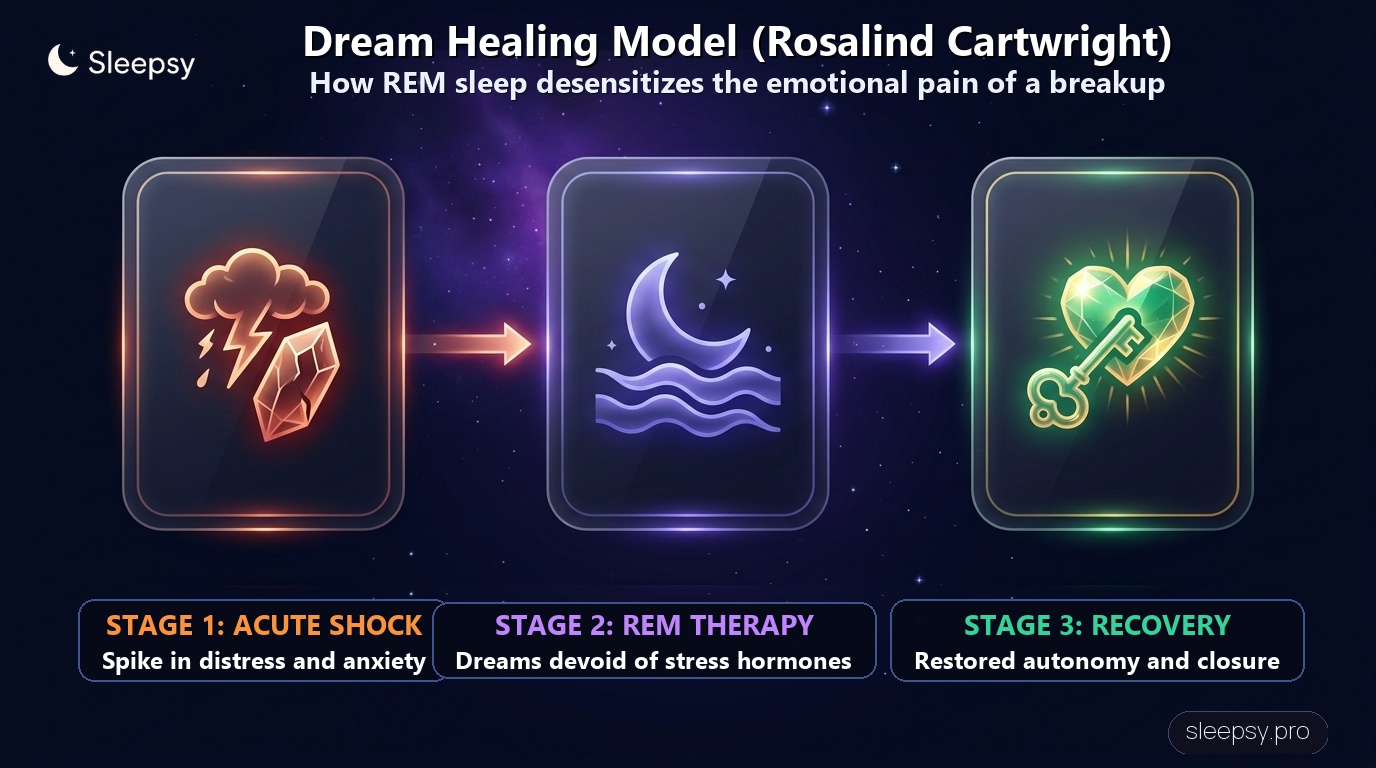
Cartwright demonstrated that dreaming about an ex is not a symptom of emotional regression. On the contrary, it signals the active reorganization of attachment schemas. The mind dismantles the outdated “We” construct to construct a resilient, autonomous “I.”
Gestalt and Jungian Perspectives: Your Ex as an Internal Mirror
In Fritz Perls’ Gestalt therapy, a foundational principle applies to dream work: every figure in your dream represents an aspect of yourself. When an ex-partner appears, your subconscious often projects onto them qualities you have disowned, repressed, or long to reclaim.
Consider this diagnostic question: “What specific demeanor did this person exhibit in your dream?”
- If an ex appears confident, audacious, and unapologetically free, while in your waking life you feel constrained by rigid social expectations or hyper-responsibility, your mind is likely longing not for that person, but for your own uninhibited voice and the power to set boundaries.
- If they appear cold, dismissive, and rejecting, you may currently be experiencing vulnerability, imposter syndrome, or fear of abandonment in a professional or social setting today.
- If you witness nostalgic, romantic scenes from the very beginning of the relationship, your psyche is signaling a deficit of warmth, spontaneity, or playfulness in your contemporary daily routine.
Carl Gustav Jung framed this as the interplay of the Animus (in women) or Anima (in men). An ex-partner serves as a readily available inner canvas onto which your psyche projects dialogue between the conscious ego and the deeper Self.

4 Real Triggers Bringing an Ex to Mind Tonight
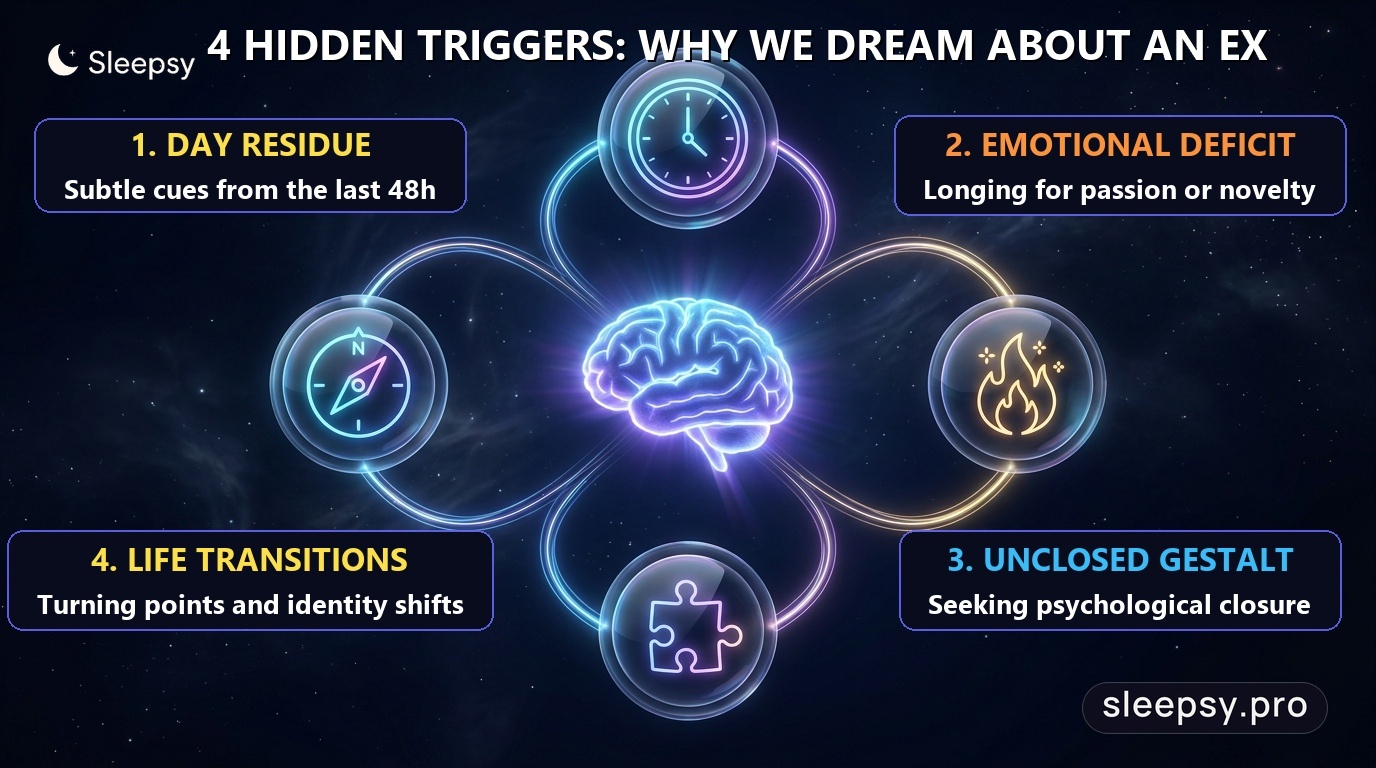
If an ex emerges unexpectedly in your sleep after years of silence, look to four primary psychological triggers:
- Associative Day Residue: A subtle, fleeting sensory prompt within the preceding 48 hours. You may have caught a whiff of a familiar cologne in a coffee shop, spotted a car of the same make, heard an old song, or passed a location reminiscent of a shared memory. Your conscious attention ignored it, but your hippocampus cataloged the cue and retrieved the associated neural pathway overnight.
- Present Emotional Deficits: If current routines have become monotonous or emotionally strained, the mind automatically scans historical archives for times when you felt intensely desirable, energized, or carefree.
- Unclosed Emotional Gestalts: Abrupt breakups lacking closure (such as ghosting), unspoken grievances, or unexpressed anger create open loops in memory networks that the nervous system periodically attempts to resolve.
- Major Life Transitions: An ex often symbolizes a defining chapter of your life—such as early adulthood, college years, or moving to a new city. When facing career pivots or significant milestones today, your brain revisits the memory bank associated with past foundational decisions.
Actionable Practice: 4 Steps to Decode the Dream Without Guilt
To transform a jarring dream narrative into constructive psychological insight, practice this four-step deconstruction:
- Separate Form from Emotion: Set aside the specific face and identity of the ex. Focus entirely on the core feeling of the dream: was it grief, vulnerability, anger, helplessness, triumph, or tenderness? Capture that emotional essence in a single word.
- Identify Present-Day Parallels: Ask yourself: “Where in my waking life over the past week have I felt this exact emotional tone?” Often, a sensation of rejection in a dream stems from critical feedback at work yesterday rather than a relationship from five years ago.
- Reclaim the Projection: What dominant trait characterized the ex in the dream? Acknowledge that this trait exists within your own potential. What healthy step in your waking life would allow you to integrate that quality constructively?
- Complete the Dialogue Consciously: If you found yourself pleading, arguing, or justifying yourself in the dream, write an unfiltered closure letter on paper (and discard or burn it safely). Expressing unspoken sentiments consciously relieves your sleeping brain from continuing the task overnight.
Key Takeaways
- Dreaming of an ex is not telepathy, nor is it a mandate to reconnect. It reflects your brain’s internal memory processing.
- During REM sleep, your brain conducts nocturnal therapy, reducing emotional charge from past wounds in a noradrenaline-free environment.
- Rosalind Cartwright’s clinical research proved that vivid dreams about past relationships accelerate recovery from emotional distress and identity upheaval.
- The figure of an ex often symbolizes your own present-day needs: a longing for autonomy, boundaries, passion, or creative freedom.