
Have you ever spent an entire day wrestling with a challenging question, looping through the same thoughts without success? The waking mind often circles in repetitive patterns. Yet upon drifting off to sleep and releasing cognitive tension, morning brings an elegant solution that seems to have appeared on your pillow overnight.
In sleep psychology, this practice is known as targeted dream incubation. It requires no mystical rituals or esoteric fortune-telling. We simply help the human brain transition into open associative exploration while the physical body enjoys restorative rest.
The Biology of Insight: Why Day Stalls and Night Finds Answers
During daylight hours, human attention is governed by the prefrontal cortex. This region operates through rigid logic, filtering out any associations that appear non-standard or unconventional.

When you fall into twilight drowsiness (the N1 sleep-onset stage), daytime censorship softens. Neural networks begin connecting distant memory traces that waking awareness previously overlooked.
As demonstrated in landmark experimental research on targeted dream incubation at sleep onset, delivering subtle thematic prompts during the hypnagogic boundary markedly elevates creative cognitive flexibility and enables minds to uncover non-obvious associative solutions upon waking.
As sleep deepens across the night, an even more sophisticated cognitive mechanism engages: according to cognitive neuroscientists investigating memory replay in sleep and creative problem-solving, slow-wave non-REM sleep abstracts overarching principles from recent experiences, while subsequent REM sleep weaves remote conceptual associations together.
The sleeping mind works like a quiet library after closing hours. It reorganizes scattered daytime impressions into coherent mental models without waking hurry.
Hypothetical Scenario: When a Jammed Lock Unlocks in Sleep
Consider a scenario where an artisan specializes in antique wood restoration. A valuable eighteenth-century secretary desk arrives with a stubbornly jammed secret compartment.

For days, the restorer studies mechanical diagrams, inspects internal crevices, and fears damaging the intricate woodwork. Direct cognitive strain leads straight to mental exhaustion.
Applying the incubation protocol, the craftsman writes a simple question on paper and places a brass key on the nightstand before bed. In a dream, an ornamental wooden vine appears, where pressing a single carved leaf pivots the central stem effortlessly upward.
“Upon waking in silence, the solution clicked instantly: the desk’s hidden release was not a sliding latch, but a concealed rotational pivot behind the side trim.”
By releasing daytime tension, the subconscious synthesized tactile memories into an elegant spatial answer. The compartment opened smoothly without a single scratch.
Step-by-Step Protocol: 4 Rules of the Evening Prompt
To establish productive nocturnal communication, formulate your bedtime query with care. Vague requests yield vague, surreal impressions.
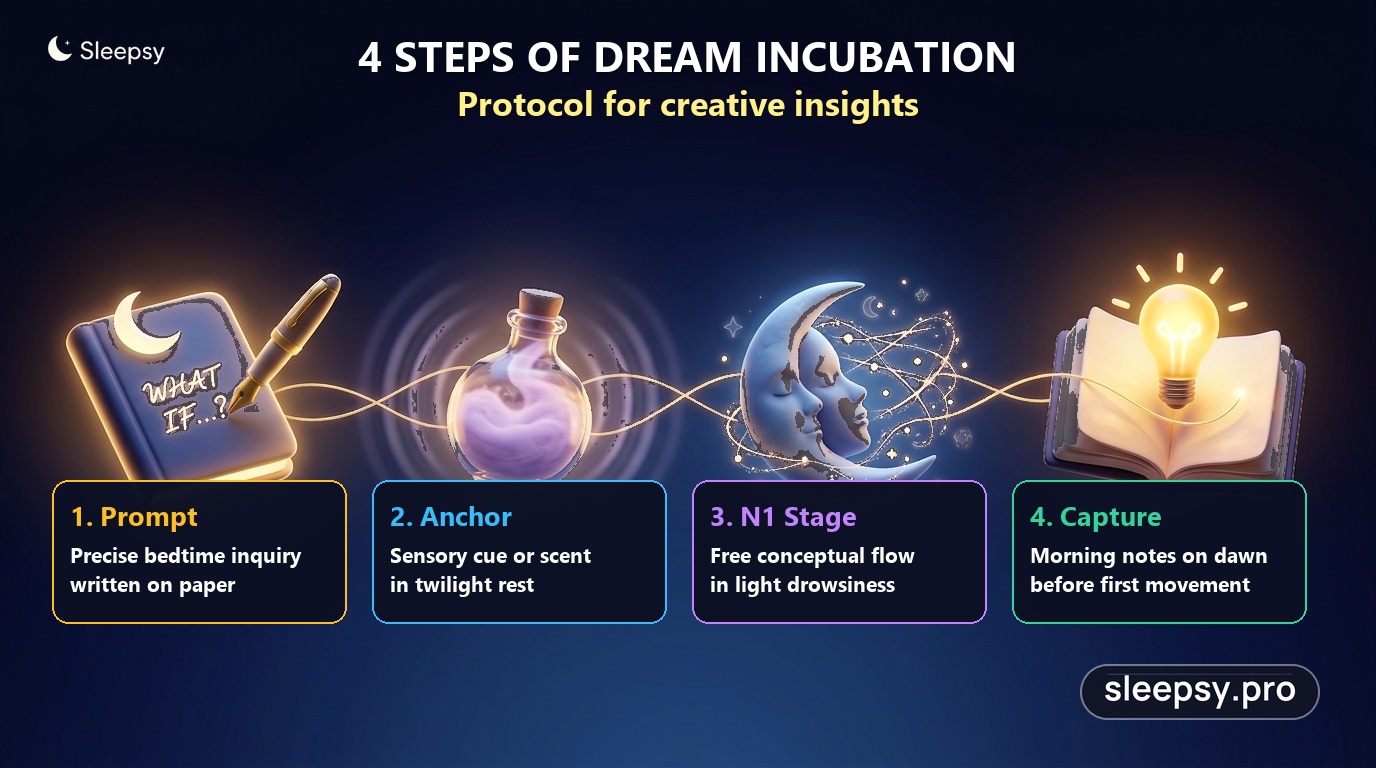
Follow four fundamental guidelines for evening cognitive priming:
- Single clear inquiry: Focus on exactly one priority. Instead of asking “How should I handle my career?”, ask “What boundary should I set in tomorrow’s meeting?”.
- Handwritten phrasing: Write the question in a bedside notebook. Physical handwriting activates motor and spatial memory far more effectively than a glowing screen.
- Sensory anchor: Associate the inquiry with a physical object—a stone, a sketch, or a quiet lavender scent. Tangible anchors reinforce intention.
- Releasing active control: As you turn off the light, stop seeking answers. Allow thoughts to drift naturally as the body unwinds.
Think of this as planting a seed in fertile soil: once planted, leave it undisturbed throughout the dark hours so roots can form.
Ancient Sanctuaries vs Modern Labs: Evolution of the Method
Humanity has cultivated dream consultation for thousands of years. In ancient Mediterranean Asclepeia, seekers slept in quiet colonnades to receive healing guidance.

In traditional cultures, elders retreated to quiet nature to clarify tribal dilemmas. While our ancestors viewed these insights through divine lenses, the underlying biology remains identical.
Modern sleep laboratories at Harvard and MIT use targeted sensory cues to replicate this natural mechanism. Research confirms what historical observers intuited: quiet evening intention shapes the narrative trajectory of nighttime cognitive replay.
Incubation Scenarios: 4 Common Inquiries and Dream Clues
Dreams rarely deliver neat arithmetic formulas. Instead, they express subconscious insights through vivid metaphors, similar to what fish symbolize in dreams and intuitive processing.

Here are four typical incubation contexts and their nighttime languages:
- Complex creative blocks: Designers or writers often dream of changing rooms, unexpected architecture, or unusual tools. Notice whichever item functions effortlessly in the dream.
- Relationship dilemmas: When evaluating a partnership, dreams often present bridges, locked doors, or weather changes. How you feel crossing that threshold mirrors your waking emotional truth.
- Career transitions: Professional crossroads frequently evoke transportation imagery—navigating trains, missing flights, or finding quiet footpaths. Pay attention to who holds the steering wheel.
- Physical fatigue and boundaries: Overextended schedules manifest as leaking vessels, crumbling walls, or heavy luggage. These images signal an urgent need to shed extraneous burdens.
Every metaphor represents your inner wisdom cutting through daytime self-deception with refreshing honesty.
Morning Protocol: Preserving the Insight in the First Seconds
The most delicate phase of dream incubation occurs during the first moments of waking consciousness. Morning neurochemistry shifts rapidly, and daylight logic swiftly washes away fleeting nocturnal imagery.

To preserve your subconscious findings, practice three gentle morning habits:
- Remain still: Do not jump out of bed or reach for your smartphone. Keep your eyes closed for sixty seconds and replay the final dream fragment.
- Record raw keywords: Note single sensory words, colors, or emotional impressions immediately in your bedside journal without attempting full grammar.
- Reflect without haste: Ask yourself: “What waking situation mirrors this exact emotional feeling?”. Often, the connection becomes obvious over morning tea.
Sleepsy helps you capture and organize morning impressions effortlessly. We take into account your waking life context, filtering out background noise so intuitive hints connect with your real priorities.
Dreams never command or impose rigid rules. They gently illuminate what your deeper self already understands, but daytime vigilance hesitates to acknowledge.
Key Takeaways
Here are clear anchors for peaceful evenings and insightful sleep:
- Science over superstition: Dream incubation relies on natural memory consolidation and associative networks, not mystical predictions.
- The hypnagogic window: During gentle drowsiness (N1), the brain relaxes logical censorship and explores novel perspectives.
- One question rule: Dedicate each evening to a single concise query to avoid cognitive clutter.
- Morning quiet minute: Sixty screen-free seconds upon waking protect fragile dream insights from fading.
Core Takeaway: Dream incubation is not magic—it is an authentic dialogue with your deeper mind. By formulating a calm evening intention and preserving morning quiet, your night becomes a trusted ally.