“I woke up in sheer confusion: I saw a massive, calm fish swimming in crystal-clear water. Does this unmistakably mean pregnancy?”
Queries like this appear in morning dream searches with astonishing regularity. People immediately turn to historical folklore: archaic texts promise imminent motherhood, others predict sudden wealth, while darker proverbs warn of adversity hidden beneath stagnant weed-choked ponds.
The immediate impulse upon waking is often to search online forums for superstitious omens or rush to confirm literal predictions.
Generations of cultural folklore have conditioned us to believe that ancient nocturnal symbols must predict external fate. Yet blind faith in medieval omens merely replaces meaningful self-dialogue with borrowed anxieties and empty dread.
A dream about fish is fundamentally the sleeping brain holding an honest conversation with itself.
It rarely reflects conception or sudden material windfalls. In psychological terms, the aquatic world represents the vast reservoir of the subconscious, while the fish itself serves as an archetypal symbol for an emergent intuitive thought or creative solution. It is a direct signal that an internal decision has finally matured and is ready to breach the surface of conscious awareness.
What Traditional Dream Dictionaries Claim: Miller, Vanga, Freud, and Loff
Typing nocturnal doubts into a search bar typically unleashes an overwhelming flood of contradictory forecasts.
Historical authors viewed nighttime imagery through the cultural biases and moral frameworks of their respective eras:
- Gustavus Miller’s Dream Book: Tied aquatic plots strictly to material prosperity and social prestige. If a dreamer witnessed living fish swimming in clear streams, Miller promised generous gifts of fortune and rapid professional advancement. For young women, he foretold enduring romance and impending marriage. Conversely, dead or belly-up fish portended bitter grief, dashed expectations, and lingering disappointment.
- Folk Seer Vanga: Framed the appearance of fish as a fateful spiritual milestone. A pristine river pool filled with healthy fish was seen as a promise of joyful tidings, inner purification, and domestic tranquility. Catching a fish with bare hands symbolized a rigorous test of integrity, requiring an agonizing moral choice. Stagnant backwaters or decaying fish were treated as warnings of hidden adversaries plotting deceit.
- Sigmund Freud: Translated the underwater realm into the language of repressed instinct and psychosexual energy. Freud categorized fish as classic symbols of fertility and latent erotic longing. Successful fishing mirrored an unconscious hunger for passion and emotional intimacy lacking in daily life. When a fish slipped away through open fingers, he identified an unspoken dread of sexual inadequacy or fading attractiveness.
- David Loff: Pioneered a transition away from rigid prophecies toward personal psychological context. For Loff, fish narratives reflected an active search for internal resources to satisfy core emotional needs. Fishing symbolized determined efforts to regain control over slipping circumstances at work or in relationships. Loff urged dreamers to evaluate not the size of the catch, but their feelings toward the water: serene peace, fear of the abyss, or focused excitement.
- Folklore and Superstitions: Solidified the stubborn myth that fish dreams signify pregnancy. The superstition stems from archaic fertility cults where fish embodied the genesis of life within primordial waters. Other regional proverbs promised sudden riches, while murky currents were blamed for malicious gossip, emotional tears, and physical illness.
Why Superstitions Fail: Waking Context Determines the Meaning
Consider the wild contradictions: from joyful marriage to financial ruined hopes and debilitating illness. When old interpretations clash at every turn, relying on them yields zero practical guidance.
Traditional dream dictionaries fail because they attempt to force a medieval template onto living, breathing human beings. A nocturnal symbol stripped of your waking context is completely hollow: genuine meaning lies in the emotions felt during the dream and the daytime realities you navigate.
Compare two ordinary waking realities.
An industrial manufacturing worker dreams of holding a living fish after enduring months of exhausting overtime shifts. For her, the image is an intuitive plea for rest and transition away from grueling physical strain.
Meanwhile, a professional planning an international relocation dreams of a fish slipping away. Here, the imagery mirrors the natural anxiety of losing familiar footing in a foreign environment, much like pregnancy dreams symbolize the gestation of major life transitions rather than literal babies.
One identical archetype. Two radically distinct psychological meanings.
At Sleepsy, we do not indulge in superstitions or mystical catalogs. We connect nocturnal storylines directly with daytime stress patterns, helping you interpret subconscious guidance with scientific clarity.
| Nocturnal Dream Narrative | Traditional Superstition Claim | Sleepsy Evidence-Based Perspective |
|---|---|---|
| Living fish in pristine, transparent water | Imminent pregnancy or sudden financial windfall | Clear connection with intuition and profound emotional equilibrium |
| Catching a fish bare-handed and holding it securely | Impending wedding or triumph over rivals | Readiness to claim an intuitive decision that has matured in the subconscious |
| Fish wriggling free and escaping into the deep | Financial ruin or deceitful betrayal of hope | Hypercontrol crisis: clinging to outcomes where natural flow must be trusted |
| Murky stagnant pool or lifeless fish | Grave illness, malicious hex, or mourning tears | Severe emotional fatigue, burnout, and an urgent physiological call to recharge |
Dreams About Fish: 4 Psychological Scenarios
The waking mind tends to fixate on surface visuals.
In depth psychology, however, fish act as ambassadors from the unconscious, heralding an emerging intuitive breakthrough. The sleeping brain activates this primal nature metaphor whenever daytime logical analysis reaches a stalemate and cannot perceive the obvious solution.
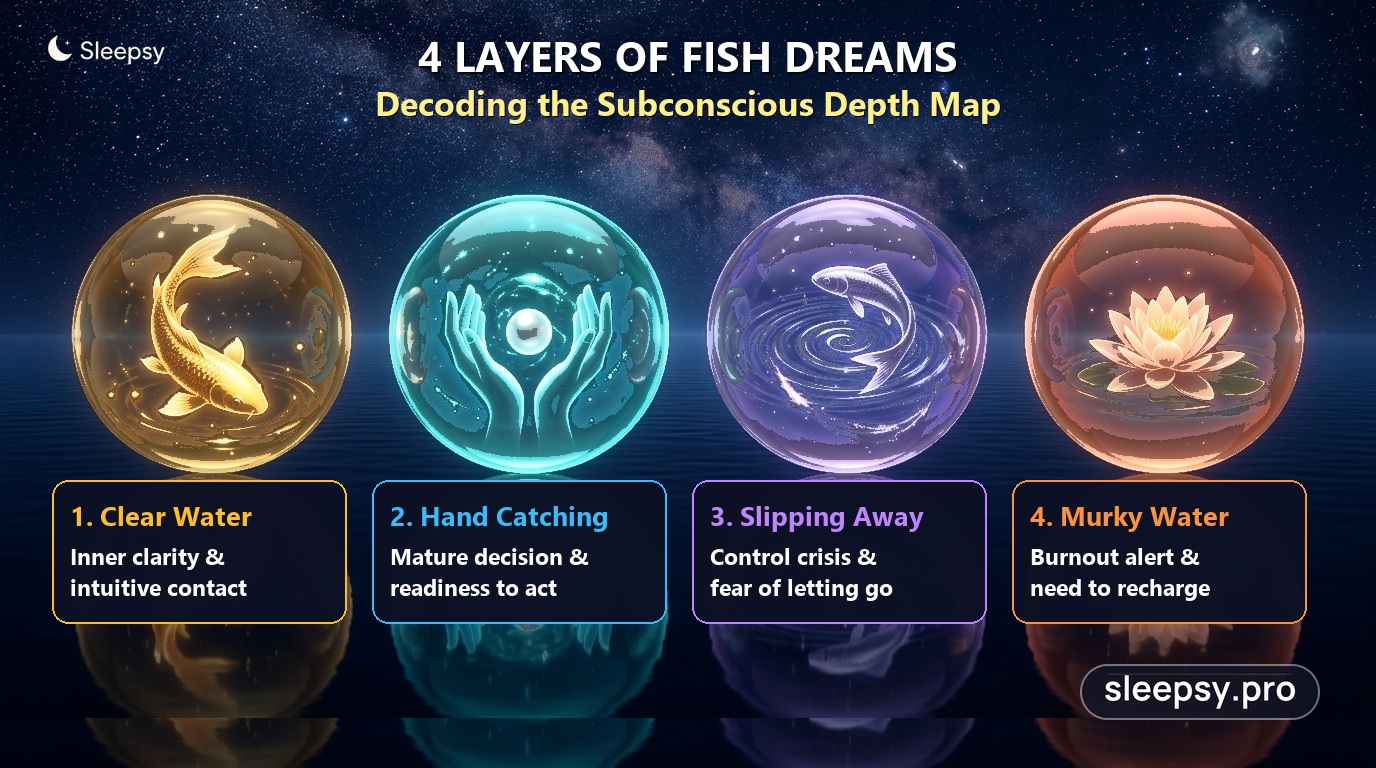
The specific conditions of the aquatic narrative precisely reflect your current internal balance:
1. Living Fish in Clear Water: Inner Lucidity and Subconscious Harmony.
Watching a majestic fish glide effortlessly through sunlit, pristine water brings a profound sense of serene wonder upon waking. The dream carries neither predatory urgency nor anxiety: you simply witness the graceful movement of a vital creature. In psychology, transparent water confirms that mental clutter and superficial daytime chatter have quieted down, revealing your true priorities.
In waking life, this scenario reflects deep internal alignment. Your intuition has quietly located the right course of action through a confusing dilemma, and your inner compass is functioning flawlessly. If you have been wrestling between conflicting options, the dream confirms that the optimal path has already crystallized within you: it is safe to trust your initial instinct.
2. Catching a Fish with Bare Hands: Matured Decisions and Courage to Act.
A dream where you catch a vigorous living fish bare-handed and hold it firmly brings an electrifying surge of vitality. Cold water swirls around your wrists, scales shimmer against your palms, yet you feel steady confidence and triumphant joy. In ancient cultures, this gesture symbolized claiming vital sustenance; in modern psychology, it represents claiming the authority over your own life choices.
In waking reality, you may have spent months nurturing a bold idea, weighing risks, or postponing a necessary boundary conversation out of fear of judgment. Holding the fish demonstrates that the passive phase of second-guessing is over. Your psyche has gathered adequate emotional resources: the moment has arrived to step forward and own your path.
3. A Fish Slipping Through Your Fingers: The Hypercontrol Trap.
Few nocturnal plots are as emotionally exhausting: the fish thrashes in your grip, slips through your fingers, and darts into the murky deep, leaving behind a bitter wave of frustration. The dreamer frequently wakes with clenched fists and feelings of inadequacy. Yet this narrative does not reflect incompetence; it exposes the futility of trying to micromanage unpredictable events.
In your daytime routine, you may have taken on an unsustainable burden: attempting single-handedly to rescue a strained partnership, fix coworkers’ mistakes, or force life into rigid expectations. The dream offers a visceral demonstration: the tighter you squeeze your fists, the faster you lose hold of that which thrives only in open waters. It is time to release the grip and allow life to unfold naturally.
4. Murky Stagnant Waters and Lifeless Fish: Physiological Exhaustion Alert.
A weed-choked backwater, cloudy suspended silt where dark shapes lurk, or dead floating fish evoke visceral unease and invite superstitious dread. Do not succumb to scary folklore: dreams never predict supernatural misfortune. They serve as an uncompromisingly honest mirror of an overtaxed nervous system.
Lifeless fish and stagnant water reflect chronic compromises, emotional burnout, and living on automated survival routines. You may have spent months ignoring your body’s signals, tolerating toxic environments, or suppressing resentment. The sleeping brain is delivering an undeniable wake-up call: internal reserves are completely depleted. You urgently need quiet downtime, boundaries, and gentle self-compassion.
Case Exploration: Silver Fish at Dawn
Consider a hypothetical scenario involving an industrial heavy-machinery operator who spent more than two decades working twelve meters above a roaring factory floor. Accustomed to shouldering immense responsibility without complaint, she chronically silenced her mounting exhaustion with overtime shifts. When rumors of structural reorganization spread through the plant, a persistent fear of job loss began creeping into her waking life. Although a quieter transfer to logistics and inventory was available, she repeatedly postponed the transition, dreading the loss of familiar identity and fearing it might seem like a concession.
Then came an indelible dream. Dawn broke over a wide, tranquil river. Cool, crystalline water lapped against her tired feet, washing away the metallic drone of the industrial floor. Suddenly, emerging from the quiet depths directly toward her, a large silver fish with golden fins surfaced, gazed calmly into her eyes, and settled gently into her weathered hands, radiating a living, soothing warmth. In that singular instant, months of heavy chest tension dissolved into deep, restorative peace.

“Upon waking, the heavy morning dread had vanished for the first time in months. It felt as if a calm inner voice was reassuring me that I had done everything I could, and that it was finally safe to let go and choose a gentler path.”
This nocturnal image had nothing to do with folk omens or ancient pregnancy superstitions.
The silver fish voluntarily resting in open palms served as an embodied metaphor for an intuitive resolution that had already matured within the subconscious. Recognizing this insight provided the emotional clarity needed to accept the quieter transfer, bringing an end to chronic insomnia and anxiety about the future.
Overtime night shifts became a thing of the past, making room for revitalizing rest and renewed self-respect.
The Neurobiology of Sleep: How the Brain Catches Insights
Why does the sleeping brain so frequently select the imagery of fish and aquatic depths?
During waking hours, conscious attention rigorously filters sensory input: we focus strictly on tasks dictated by calendars and deadlines. Thousands of background impressions—subtle vocal inflections of colleagues, minor muscular tensions, quiet intuitive doubts—are dismissed as irrelevant noise and pushed down into long-term memory, like pebbles resting beneath dark river currents.
During the night, logical inhibition from the prefrontal cortex eases, allowing subconscious processing to claim center stage.
In a landmark neuroscience investigation of associative memory during sleep, neurobiologist Robert Stickgold demonstrated that rapid eye movement (REM) sleep triggers a state of hyperassociativity, dramatically strengthening distant semantic links. While waking cognition relies on linear, predictable mental schemas, REM sleep discovers profound metaphorical parallels, transforming diffuse daytime observations into vivid archetypes like a living fish rising from the depths.
The fish in your dream is not an omen; it is a visual crystallization of a complex thought that incubated in the dark and finally surfaced.
Further reinforcing this mechanism, a comprehensive experimental study on creative problem-solving during REM sleep led by Denise Cai revealed that REM sleep enhances the integration of unassociated information by nearly forty percent. The sleeping brain independently synthesizes fractured data into coherent solutions, allowing the individual to effectively catch the elusive answer and hold it securely in their hands.
This explains why successfully catching a fish in a dream delivers such profound relief upon waking: your brain has completed monumental cognitive work and delivered a finished insight.
Morning Reflection: 4 Steps Instead of Superstitions
When waking from a dream about fish, resist the temptation to consult dubious fortune-telling websites. A mindful internal audit offers far greater practical value for identifying what your subconscious is signaling:
1. Reflect on the Clarity of the Water.
In analytical psychology, water symbolism in dreams consistently mirrors emotional equilibrium. Crystalline currents signify inner lucidity and peace, swift white-water reflects rapid life transitions, while murky stagnant water reveals suppressed resentment or prolonged emotional fatigue.
2. Check Your Somatic Resonance.
What sensations accompanied the dream in those initial moments after waking? If your chest felt expansive and warm, your subconscious is endorsing your pending plans. If your shoulders were tight or breathing shallow, your nervous system is signaling unaddressed tension.
3. Identify the Matured Decision.
Ask yourself with unvarnished honesty: what vital choice have I been chronically putting off? In which domain of life is it time to stop tolerating discomfort—in career routines, interpersonal dynamics, or personal health boundaries?
4. Take One Tangible Real-World Action.
Every intuitive insight requires grounding in waking reality. Write down the realization in a journal, initiate an honest conversation with a supportive friend, or schedule an uninterrupted rest day free of guilt.
Key Takeaways and Awakening Resources
A dream featuring fish is not an excuse for superstitious dread, but a valuable invitation to deepen your relationship with personal intuition:
- Superstition vs. Neuroscience: Archaic omens about pregnancy or sudden gold divert attention from real psychological needs, whereas cognitive science views fish as emergent insights.
- Depth Metaphors: Water transparency and the vitality of the fish directly represent your current emotional balance and readiness for transition.
- Mechanisms of REM Sleep: Rapid eye movement sleep integrates scattered daytime experiences, bridging distant memories into coherent solutions.
- Mindful Action: Grounded morning reflection translates nocturnal symbolism into decisive, confident action in your waking world.
Key Insight: The fish in your dream does not predict future fortune; it reveals the intuitive resolution already swimming within you. Trust your inner compass and allow that matured insight to guide your waking choices.