Few nocturnal visions leave as visceral a somatic shock as dreaming that your home is engulfed in flames. You stand paralyzed with an empty bucket while a roaring blaze consumes everything, only to awaken with a racing pulse, dry heat in your chest, and lingering dread. Yet modern analytical psychology and sleep science demonstrate that nocturnal blazes never prophesy financial catastrophe or literal misfortune. Fire in dreams signals the outer limits of psychological endurance, reflecting suppressed anger, chronic burnout, and an urgent inner demand for emotional renewal.
The sleeping mind employs primordial elemental imagery not to frighten, but to communicate an unavoidable truth. When daytime routines demand endless emotional restraint, the subconscious deploys fire as a biological alarm: outdated coping strategies and worn-out boundaries can no longer contain your accumulated psychological pressure.
What Traditional Folklore Says About House Fires: Miller, Vanga, Freud, and Loff
For centuries, the phrase dreaming of a house fire sent anxious dreamers searching through traditional dream books. Historical interpretations are filled with categorical, often alarming omens that distract from the authentic psychological roots of nighttime distress.
- Gustavus Miller’s Interpretation: Miller associated bright, roaring flames without human casualties with impending renewal, purification, and good fortune in upcoming endeavors. However, viewing charred ruins or fruitlessly attempting to extinguish the flames was deemed an omen of material loss, sudden illness, and shattered expectations.
- Vanga’s Mystical Tradition: In eastern folk folklore, a burning home was seen as a warning of impending trials, malicious gossip, or family conflict. Acrid black smoke was framed as looming adversity, whereas clear, bright flame was interpreted as shedding chronic illness or initiating a household rebirth.
- Sigmund Freud’s Psychoanalytic View: Freud regarded open fire as a direct somatic manifestation of passionate drive, repressed libido, and unconscious desire. Struggling against flames in a dream reflected anxiety surrounding the loss of conscious control over instinctive emotional impulses.
- David Loff’s Contextual Approach: Loff offered a more modern perspective, emphasizing the dreamer’s emotional state. Experiencing acute panic mirrored a waking loss of personal control, whereas calmly watching the flames represented readiness to release the past in exchange for a fresh chapter.
Traditional dream dictionaries make a fundamental error: they isolate the symbol from the living individual. Fire experienced by an exhausted clinician, a primary caregiver, or an entrepreneur facing a precarious partnership carries fundamentally different psychological meanings.
Consider how identical dream motifs yield radically different interpretations when viewed through waking reality:
| Dream Narrative | Superstitious Interpretation | Sleepsy Psychological Insight |
|---|---|---|
| Personal home on fire | Impending financial loss and family discord | Critical boundary exhaustion and an urgent need to protect your emotional space |
| Attempting to quench fire with water | Futile labor and legal entanglements | Exhausting attempts to exert control over an unsustainable lifestyle requiring systemic change |
What Science Reveals: REM Sleep and Stress Processing
Contemporary cognitive neuroscience has dispelled the mysticism surrounding nighttime disasters. Dream scenarios are primarily synthesized during Rapid Eye Movement (REM) sleep, when emotional processing networks reach peak activity while somatic motor commands remain physically inhibited.
As detailed in a systematic review on the functional role of dreaming in emotional processes, REM sleep operates as a natural nocturnal therapy: the sleeping brain suppresses noradrenaline release, allowing the amygdala to recalibrate waking emotional distress in a neurochemically safe offline environment.
When you suppress anger during waking hours, tolerate toxic work environments, and absorb chronic tension, that emotional energy does not vanish. At night, the sleeping brain constructs metaphors of maximum intensity to house the sheer scale of suppressed affect. Raging fire becomes the brain’s ideal neurobiological language for venting internal emotional overheating.
This adaptive mechanism is corroborated by a comprehensive cross-cultural study on the emotional adaptive function of dreams, which demonstrated that nighttime simulations of acute threats—such as raging fires and crises—correlate with reduced waking anxiety by conditioning the mind to confront intense emotional demands.
Hypothetical Scenario: When Fire Consumes Exhaustion
Consider a hypothetical scenario involving an executive culinary director who co-owns a thriving urban bistro. Working twelve-hour shifts over blistering kitchen ranges for three years without vacation, this professional shoulders continuous staffing shortages alongside a business partner demanding cheaper commercial shortcuts.
Night after night, the same dream unfolds: during an overwhelming dinner rush, the kitchen fryers suddenly ignite. Flames race up wooden shelving and exhaust hoods, engulfing the room in a roaring wall of fire. Reaching for a heavy fire extinguisher, the dreamer triggers the nozzle—only for dry, gray ash to pour out instead of foam. As the commercial kitchen walls buckle and collapse, the scene gives way to an ancient stone foundation and a quiet, star-filled night sky.
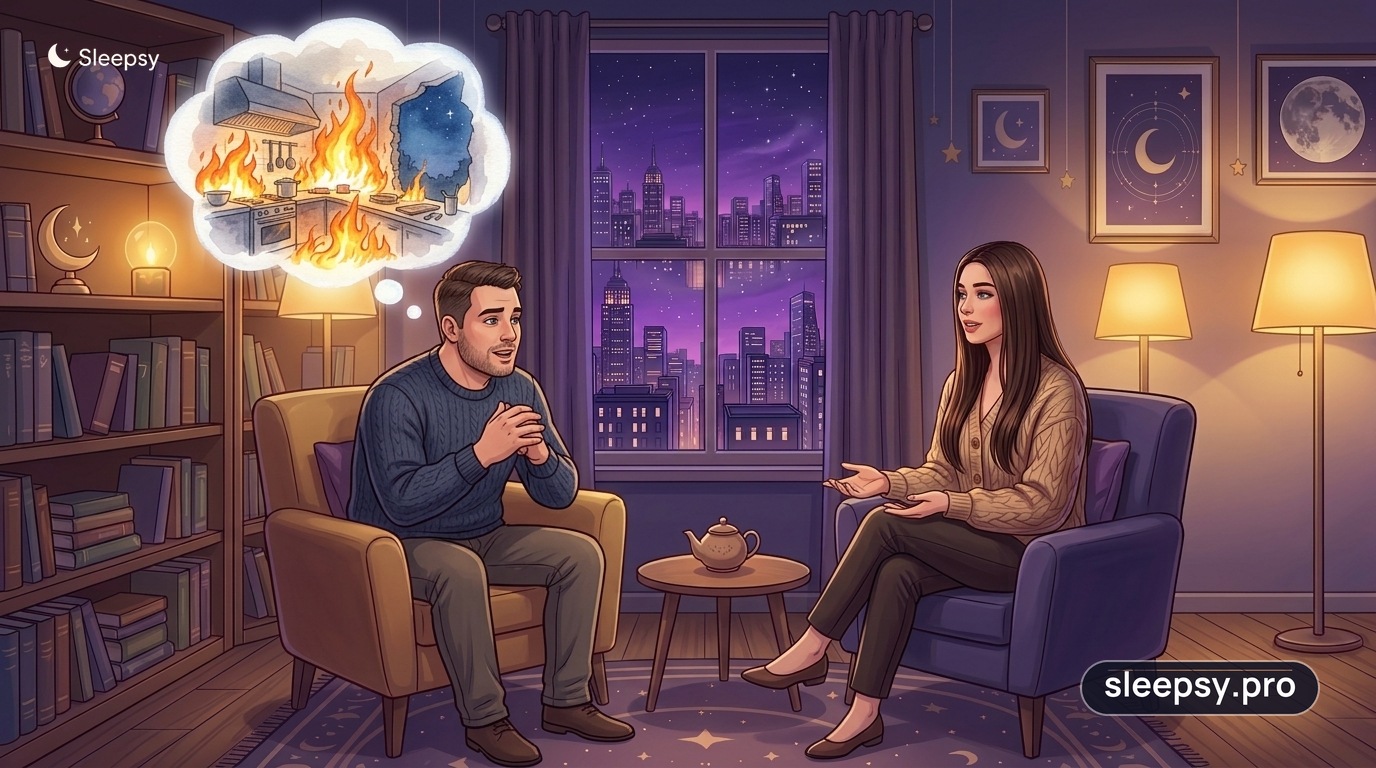
“The most striking element was not the terror of the flames,” the dreamer reflects. “It was the profound wave of relief. Watching the kitchen burn, I realized that tomorrow I wouldn’t have to show up, appease unreasonable demands, and pretend everything was fine.”
In analytical psychology, this narrative reveals months of suppressed resentment. The partner’s demands compromised professional values, yet fear of confrontation fostered silence and excessive overwork. The inferno was not a prophecy of commercial downfall, but an authentic mirror of internal collapse: professional patience had burned to the ground.
By consciously recognizing this message, an individual in this position can stop tolerating destructive compromises. Addressing fundamental disagreements openly transforms the dream from a terrifying nightmare into a catalyst for self-preservation and healthy boundary renegotiation.
Anatomy of a Dream: Why Context Outweighs Symbols
In Carl Jung’s analytical framework, a house represents the holistic architecture of the psyche. The foundation anchors foundational familial blueprints; exterior walls delineate personal boundaries and social defense; the roof represents conscious cognitive beliefs and intellectual governance.
When you experience dreams about a house fire, the surrounding emotional context is paramount. Fire can manifest as a terrifying force of destruction, or it can operate as a cleansing agent, consuming accumulated emotional debris. Without mapping current life stressors, isolated symbols remain uninformative.
If you are navigating an agonizing personal parting, nocturnal flames often reflect the painful disintegration of old attachments and illusions. If your schedule is crushed under excessive workplace obligations, fire articulates physical and mental depletion. Sleepsy interprets every dream through the holistic lens of your daily stress patterns, sleep routines, and active life transitions.
4 Psychological Scenarios of a House Fire in Dreams
To identify which waking sphere your subconscious is bringing into focus, examine precisely where the blaze originated within the dream structure.
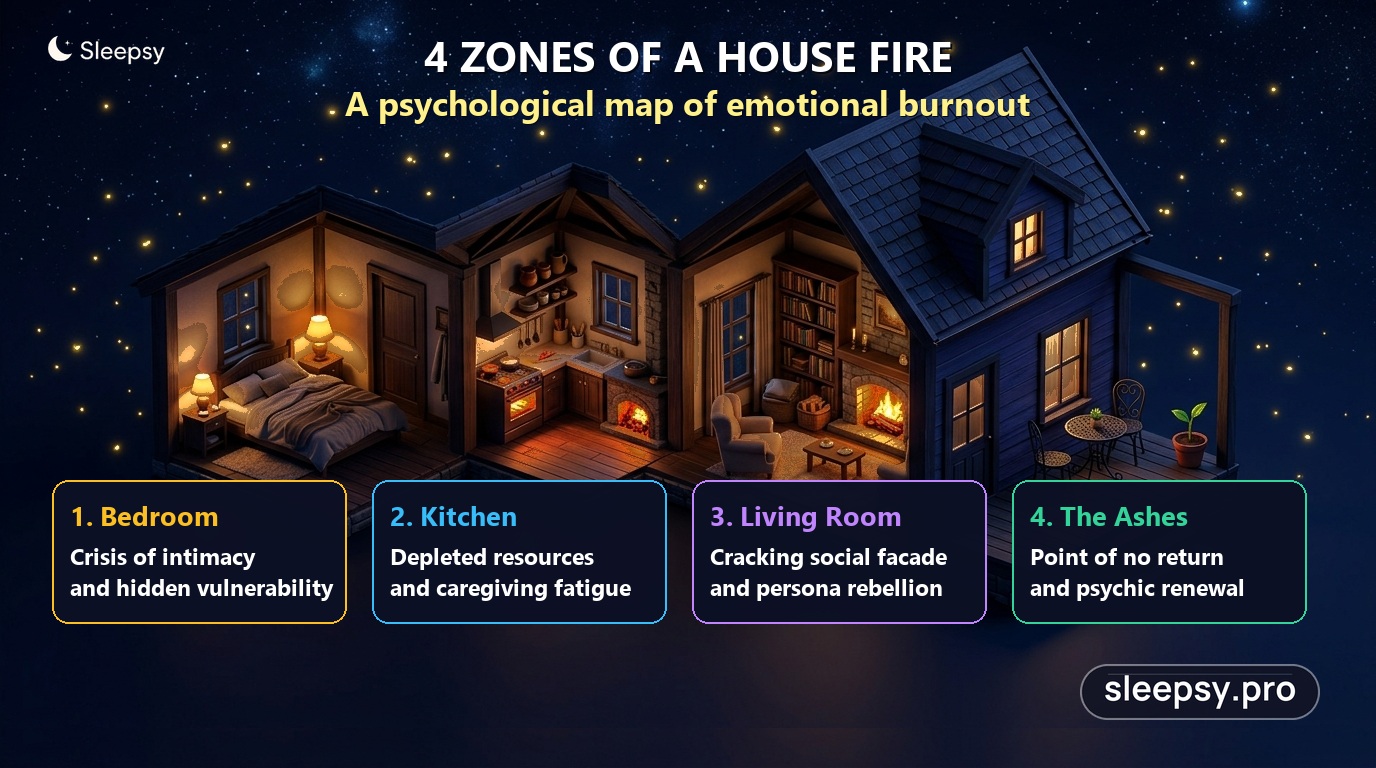
1. Burning bedroom: intimacy crisis and unvoiced vulnerability. The bedroom corresponds to emotional trust, rest, and intimate vulnerability. When flames engulf the mattress, pillows, or drapery, it points to severe emotional estrangement or unexpressed resentment in personal partnership. Suppressed emotional friction can no longer be ignored—much like how dreams about cheating reflect unacknowledged attachment anxiety and an underlying hunger for emotional safety.
2. Kitchen inferno: depleted resources and caregiver burnout. The domestic kitchen embodies nourishment, sustenance, and primal vitality. Fire in this sector signals chronic depletion in someone who carries the unrelenting burden of caring for others. The psyche sounds an alarm: the hearth has dangerously overheated, caregiving reserves are empty, and you must replenish your own energy.
3. Living room blaze: cracking social facade. The living room represents your public interface with the community and external world. Fire ignites here when an individual is weary of upholding the performance of an effortless achiever, flawless parent, or agreeable peer. It represents an authentic internal rebellion against artificial expectations and performative personas.
4. Embers and ashes: point of no return and psychic renewal. A dream where the destructive storm has subsided, leaving soft gray ash under crisp night air, marks the conclusion of an internal storm. The acute phase of emotional crisis has passed. The unconscious has eliminated outlived expectations, clearing an unburdened foundation for genuine personal renewal.
How to Decode Your Fire Dream Without Superstition
Analyzing nocturnal dreams requires neither occult rituals nor superstition. Grounded psychological inquiry relies on careful self-observation and honest self-dialogue.
Upon waking from an intense fire dream, apply this four-step reflection framework:
- Identify the somatic emotion: Reconnect with what you felt during the dream—paralyzing horror, numbness, fury, or unexpected relief? Your somatic emotional reaction points directly to the underlying conflict.
- Locate the waking source of heat: Where in your daily routine are you enduring an unsustainable, escalating situation? Who or what is consuming your remaining emotional stamina?
- Discontinue futile fire-fighting: Ask yourself honestly: what dynamic are you striving to preserve that has already outlived its purpose and merely drains your resources?
- Pause and decompress: Intense fire dreams visit those who have driven themselves to exhaustion. Give yourself permission to pause and temporarily lower external performance demands.
Key Takeaways
Summarizing our psychological examination of fire dreams:
- Science vs. Folklore: Traditional folklore omens of ruin and misfortune are scientifically groundless; nighttime fires reflect emotional burnout and unexpressed resentment.
- Neurobiology of Sleep: During REM sleep, the brain uses intense fire imagery as a safety release valve for offline emotional recalibration.
- Boundary Diagnostic: The specific room engulfed by fire highlights the life area where your emotional boundaries have deteriorated.
- Psychic Renewal: Fire dreams do not merely register destruction; they clear away unsustainable commitments and teach you to voice a timely “no.”
Core takeaway: Dreaming of a burning house is not an omen of external catastrophe, but a protective alarm from your subconscious: stop sacrificing your well-being to put out others’ fires, and reclaim your fundamental right to rest.