
“I woke up at four in the morning, looked at my sleeping partner, and felt a wave of intense, irrational resentment.” This visceral confession is remarkably common among individuals seeking clarity after a turbulent night. A vivid narrative of betrayal unfolds in the dark, and morning arrives with a sticky residue of suspicion.
The instinctive reaction in such confusion is often to check a partner’s phone or frantically scroll through traditional dream books. It feels as if intuition is sounding an urgent alarm. Yet blind faith in superstitious omens merely replaces honest communication with unnecessary panic, eroding trust in the process.
A dream about infidelity rarely points to real betrayal. During sleep, the subconscious mind is not peering through keyholes; it communicates through hyperbolic drama. The narrative is a mirror of our own emotional vulnerability, cumulative exhaustion, or an unspoken psychological distance between partners.
What Traditional Dream Dictionaries Claim: Miller, Vanga, Freud, and Loff
Searching the web for answers often yields a deluge of alarming prophecies. Popular historical commentators interpreted infidelity plots through the cultural prejudices of their time:
- Gustavus Miller’s Dream Book: Evaluated nocturnal imagery through the moral lens of the early twentieth century. If a woman dreamed of her husband’s unfaithfulness, Miller warned of gullibility, legal disputes, and prolonged domestic sorrow. Being unfaithful oneself in a dream was framed as the risk of making an impulsive mistake that would destroy reputation and alienate friends.
- Folk Seer Vanga: Tied images of betrayal to karmic retribution and hidden deceit. In her folklore, witnessing a loved one’s infidelity portended severe disappointment, family collapse, and dashed hopes. If the dreamer committed the betrayal, it was treated as a warning of accumulated guilt and the urgent need for penance.
- Sigmund Freud: Shifted the drama into the realm of repressed sexual drive and unconscious desires. Freud posited that dreams of infidelity rarely reflect an actual wish to cheat. Instead, they signal boredom in the bedroom, fear of rejection, or unacknowledged fantasies of a partner who shows greater passion and attentiveness.
- David Loff: Among the first interpreters to reject literal prophecies. Loff highlighted that unfaithfulness in dreams symbolizes a perceived loss of control in waking life. Being cheated on reflects a subconscious sense of emotional estrangement, while cheating yourself represents an unconscious attempt to reclaim autonomy and assert suppressed desires.
- Folklore and Superstitions: Offer deeply contradictory claims. Some folk traditions insist an infidelity dream is an inverse omen foretelling an enduring marriage, while others warn of malicious gossip, hidden rivals, financial loss, and imminent divorce.
Why Superstitions Fail: Waking Context Determines the Meaning
Notice how starkly these interpretations clash: from urgent repentance and lawsuits to promises of everlasting love. When advice is so contradictory, it offers zero practical guidance.
Traditional dream dictionaries fail because they isolate the nocturnal image from the living individual. The storyline may be similar, but waking circumstances differ completely. Without understanding your daytime emotional reality, a dream loses all coherent meaning.
Consider two contrasting waking situations. A bride-to-be dreaming of her fiancé’s infidelity right before the wedding is experiencing a projection of cold feet and fear of life transition. Conversely, a spouse dreaming of unfaithfulness after ten years of marriage, while both work eighty-hour weeks, is reacting to a longing for forgotten emotional warmth.
At Sleepsy, we do not indulge in superstitions or crystal-ball predictions. We connect the emotional core of your dream with waking stressors, helping you gently restore genuine contact with yourself and your partner.
| Dream Scenario | Traditional Superstition Claim | Sleepsy Evidence-Based Perspective |
|---|---|---|
| Partner’s unfaithfulness | Imminent deceit, secret rival, or divorce | Acute longing for emotional closeness and fear of vulnerability |
| Your own infidelity in the dream | Public disgrace, guilt, and ruined plans | Reclaiming suppressed spontaneity, passion, and personal boundaries |
| Witnessing betrayal right in front of you | Courtroom disputes and public humiliation | Helplessness before circumstances, demanding careers, or routine |
| Infidelity with a close family friend | Hypocrisy and malicious sabotage in your circle | Blurred personal boundaries and unacknowledged social comparison |
Dreams About Cheating: 4 Psychological Scenarios
When waking from a dream about infidelity, the conscious mind tries to grasp literal explanations. In analytical psychology, however, unfaithfulness is a symbol of compromised equilibrium. The psyche sounds an alarm when daytime control drowns out authentic needs.
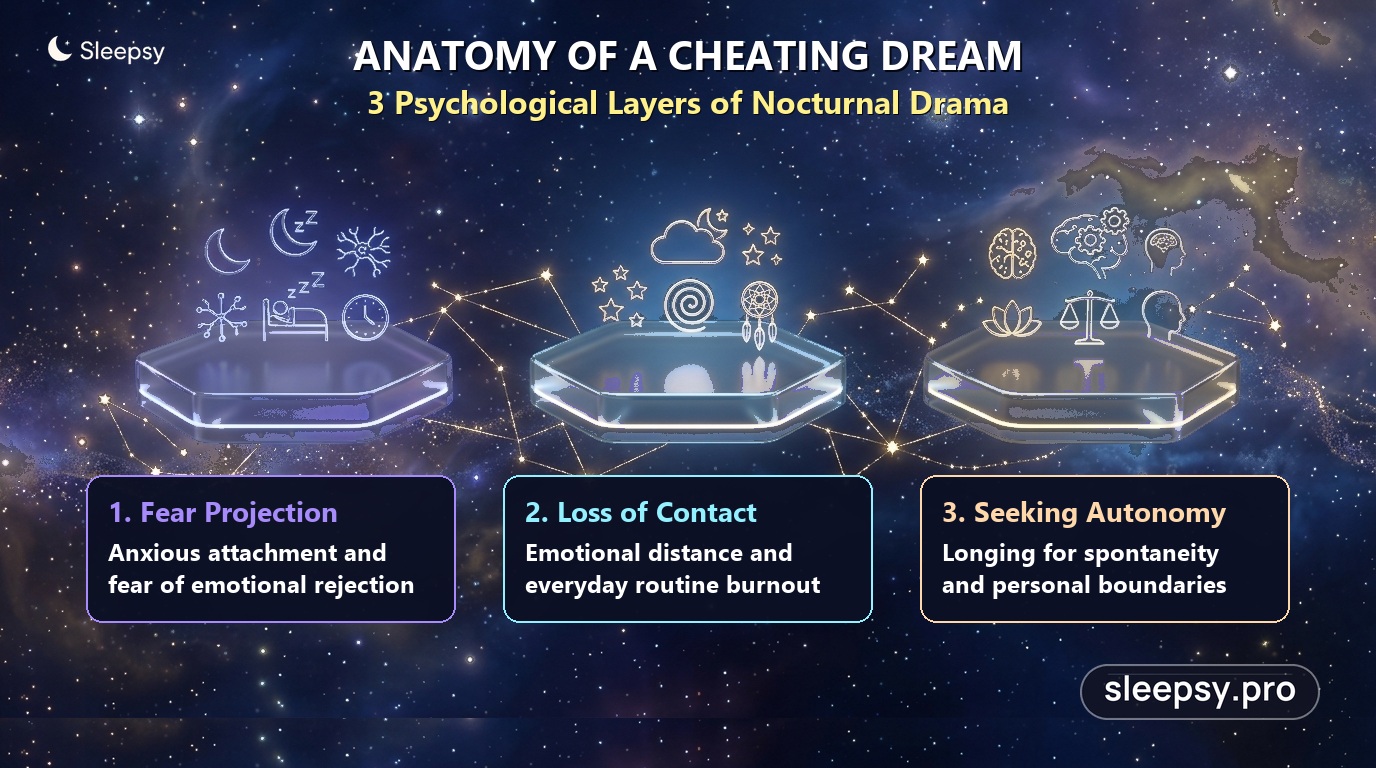
The specific dynamics of the plot indicate which area of your relationship or inner world requires care. Four distinct scenarios appear with remarkable frequency:
1. Partner’s Infidelity: Anxious Attachment and Rejection Fear.
Dreaming that your partner is unfaithful stems from a deep-seated fear of abandonment. If your partner has become quiet, preoccupied with demanding work, or exhausted, the brain amplifies that emotional distance into a full-blown catastrophe. This is not an intuition of deceit, but an urgent signal of emotional hunger and a need for reassurance.
2. Your Own Infidelity: A Rebellion Against Constricting Routines.
Waking up after dreaming of your own unfaithfulness is often accompanied by heavy guilt. Yet this storyline rarely points to real attraction toward another person. More often, it represents an exhausted psyche suffocated by domestic obligations or professional roles. Just as when dreaming about an ex, nocturnal infidelity symbolizes reclaiming spontaneity, vitality, and personal autonomy.
3. Witnessing Betrayal in Plain Sight: Suppressed Powerlessness.
Watching your partner cheat right before your eyes while feeling paralyzed illustrates a loss of agency in waking life. You may feel unable to influence vital decisions: household finances, overbearing family dynamics, or an unpredictable schedule. The dream magnifies a painful underlying belief: “My voice and preferences no longer matter.”
4. Cheating with a Close Friend: Unspoken Comparison.
When a familiar friend emerges as the rival in a dream, it does not imply actual treachery. The image of the friend embodies traits you feel disconnected from in yourself: lightness, physical confidence, or independence. The psyche does not envy the individual, but the inner freedom they represent, projecting that tension into a dramatic triangle.
Case Exploration: Unpacking the Hidden Threat
Consider a hypothetical scenario where an individual wakes up in cold sweat at four in the morning, trembling with inexplicable resentment. Her partner sleeps peacefully beside her, yet an overwhelming sense of betrayal lingers from a dream that felt painfully real.
In the dream, she walked into a bright morning room to find her partner holding hands with an unfamiliar woman at the kitchen table. He looked up with calm detachment and uttered words that stung like ice: “You can clearly see that we have grown apart.”

In waking life, her partner had never given the slightest reason for suspicion. However, over the preceding months, both had slipped into emotional survival mode: relentless work deadlines, financial pressures, and daily domestic logistics. Conversations had dwindled to task lists and perfunctory updates, leaving emotional intimacy depleted.
“I knew rationally that he was simply exhausted from long work hours, but emotionally I felt entirely abandoned. The distance felt like an impenetrable wall between us.”
The nocturnal narrative did not reveal a hidden rival; the unfamiliar figure represented the lighthearted, effortless connection the couple had lost to daily fatigue. Once she recognized this underlying distress, she chose honest vulnerability over defensive confrontation, opening a heartfelt conversation about mutual burnout that revitalized their partnership.
The Neurobiology of Sleep: Why the Brain Stages Drama
Nocturnal nightmares about betrayal are not mystical premonitions; they are the intricate work of emotional memory. When we suppress hurt during the day to avoid conflict, the brain processes that unresolved tension during rapid eye movement (REM) sleep through intense, visceral narratives.
During REM sleep, the rational prefrontal cortex is quieted, while emotional centers fire at full capacity. The sleeping brain takes a daytime pang of disconnect—“they did not reply to my text”—and scales it into a high-stakes drama of betrayal.
As highlighted by a systematic review on emotional regulation in dreaming, nocturnal narratives serve as a vital mechanism for processing intense affect: the brain simulates scenarios of vulnerability and relationship threat to modulate emotional distress and adapt the nervous system to daytime challenges.
In psychology, the lingering morning sting is known as emotional inertia. Stress hormones remain elevated upon waking, causing the conscious mind to mistakenly project nighttime resentment onto a real, unsuspecting partner.
Corroborating this mechanism, an empirical study on infidelity dreams and romantic jealousy confirmed that nocturnal imagery of unfaithfulness correlates significantly with waking relationship insecurity and fear of vulnerability, rather than genuine cues of betrayal.
The brain is simply testing the emotional security system of the relationship. By simulating worst-case scenarios in the safe theater of sleep, the psyche attempts to inoculate itself against future emotional hurt.
Morning Reflection: 4 Steps Instead of an Interrogation
If an infidelity dream leaves you shaken, the golden rule of the morning is to take a conscious pause. Resist the urge to check private messages or launch accusations over breakfast. Take a deep breath and walk through four grounding steps:
- Separate Dream from Reality: Remind yourself that your partner has committed no crime against you. The events played out entirely inside your own neural circuits.
- Identify the Underlying Emotion: What did you truly feel in the dream—fear of loneliness, frustration with coldness, or longing for passion? That feeling points to your genuine daytime need.
- Evaluate Couple Distance: When was the last time the two of you laughed together without screens or household chores? Often, the dream exposes cumulative emotional deficit.
- Speak Through “I-Statements”: Instead of accusatory phrases like “You are distant,” try honest vulnerability: “I have been missing your warmth lately. Let’s spend this evening together.”
Key Takeaways and Relationship Resources
Essential principles for navigating dreams about infidelity:
- Dream Dictionaries vs Reality: Traditional folklore stokes anxiety with talk of gossip and rivals, completely ignoring the unique context of your actual life.
- Projection of Vulnerability: A dream of a partner’s betrayal reflects anxious attachment, emotional fatigue, and a fear of being rejected.
- Reclaiming Inner Vitality: Dreaming of your own unfaithfulness signals an unconscious need for spontaneity, passion, and personal boundaries amid routine.
- Biology of Nocturnal Drama: REM sleep magnifies daytime insecurity to process emotional tension, producing temporary emotional inertia upon waking.
Key Takeaway: A dream about cheating is not a reason for interrogation, but an invitation to connect. Recognize the subconscious call for intimacy and grant yourself and your partner more genuine attention.
To decode the subtle messages of your dreams and preserve emotional harmony, explore Sleepsy. Our platform helps you understand dream symbolism, manage anxiety, and restore inner peace.