People often share this nocturnal scenario with a mix of amusement and genuine confusion: seeing a positive pregnancy test or noticing a growing belly in a dream, even when children are nowhere in their plans. Waking up from such an experience typically leaves a bewildering blend of awe, vulnerability, and mild panic.
The immediate impulse in this disoriented state is often to grab a smartphone and scan traditional dream books. We naturally crave instant reassurance and a clear explanation. However, lists of medieval superstitions usually provide contradictory omens, stoking unnecessary anxiety.
Modern dream psychology views these nocturnal narratives through an entirely different lens. The sleeping mind speaks in visceral, living metaphors. When a pivotal decision or creative venture is taking shape inside you, the psyche naturally summons the ancient biological symbol of cultivating life.
What Traditional Dream Dictionaries Claim: Miller, Vanga, Freud, and Loff
A quick web search inundates the reader with starkly conflicting interpretations. Historical commentators tried to decipher pregnancy dreams through the cultural anxieties of their respective eras:
- Gustavus Miller’s Dream Book: Mirrors strict social norms of the early twentieth century. For a married woman, pregnancy in a dream was said to portend domestic strife and misunderstandings with her spouse. For an unmarried young woman, the same image allegedly foretold gossip, ruined reputation, and deceit. Only for an expectant mother was the symbol interpreted favorably as an omen of a safe delivery.
- Folk Seer Vanga’s Traditions: Divides nocturnal signs strictly into black and white. Within marriage, dreaming of an impending arrival was viewed as a promise of joy, harmony, or an unexpected birth of twins. For a young woman, however, folklore claimed the dream predicted tears, resentment, fading affection, or betrayal by someone close.
- Sigmund Freud’s Psychoanalysis: Interpreted nocturnal imagery through repressed desires and somatic drives. The founder of psychoanalysis posited that pregnancy motifs reveal either an unacknowledged readiness for biological parenthood or an emotional deadlock in an existing relationship, triggering a subconscious urge to seek a new partner.
- David Loff’s Psychological Archetypes: Came closest to clinical psychotherapy. Loff emphasized that pregnancy dreams rarely concern actual children. Instead, they serve as universal archetypes for inner maturation, the gestation of ambitious creative endeavors, stepping into a new social status, and awakening latent creative potential.
- Popular Superstitions: Continually contradict one another. Some regional traditions associate an expanding belly with sudden financial windfalls and pleasant news, while others warn of mounting debt, emotional burdens, malicious gossip, and protracted domestic turmoil.
Why Superstitions Fail: Waking Context Determines the Meaning
Notice how contradictory these interpretations are. One source warns of public disgrace, another predicts twins, a third suspects marital stagnation, and a fourth heralds professional success. Who should you believe?
Traditional dream books fail because they detach the nocturnal symbol from the living individual. A printed table offers a single generic prophecy to millions of readers. Yet a dream stripped of your waking circumstances is entirely meaningless.
Compare two common situations. A university graduate dreams of an advanced pregnancy just before defending her thesis: for her, the motif reflects anxiety about entering independent adulthood. An entrepreneur experiences the identical dream days before launching a creative studio: for her, it mirrors the immense weight of guiding a new team.
At Sleepsy, we decode dream narratives through the lens of real daytime events. Rather than relying on arbitrary omens, our methodology helps you attune to the vital signals of your nervous system.
| Dream Scenario | Traditional Folklore Interpretation | Sleepsy Evidence-Based Perspective |
|---|---|---|
| Joyful awe at an expanding belly | Sudden wealth, inheritance, or unexpected gift | Inner alignment with the emergence of an ambitious vision or project |
| Anxious impulse to conceal the pregnancy | Malicious slander and hostility from rivals | Imposter syndrome, fear of scrutiny, and reluctance to face evaluation |
| Sudden or rapid childbirth | Noisy social gatherings and hectic chores | Psychological readiness to unveil the fruits of long internal effort |
| Panic when viewing two positive test lines | Imminent illness or a heavy family burden | Realization of an irreversible life shift: former routines have ended |
4 Psychological Scenarios Behind Pregnancy Dreams
When waking from a pregnancy dream, people frequently struggle with its literal implications. Yet in cognitive psychology, this imagery ranks among the most constructive symbols: the mind illustrates that something valuable is maturing internally.
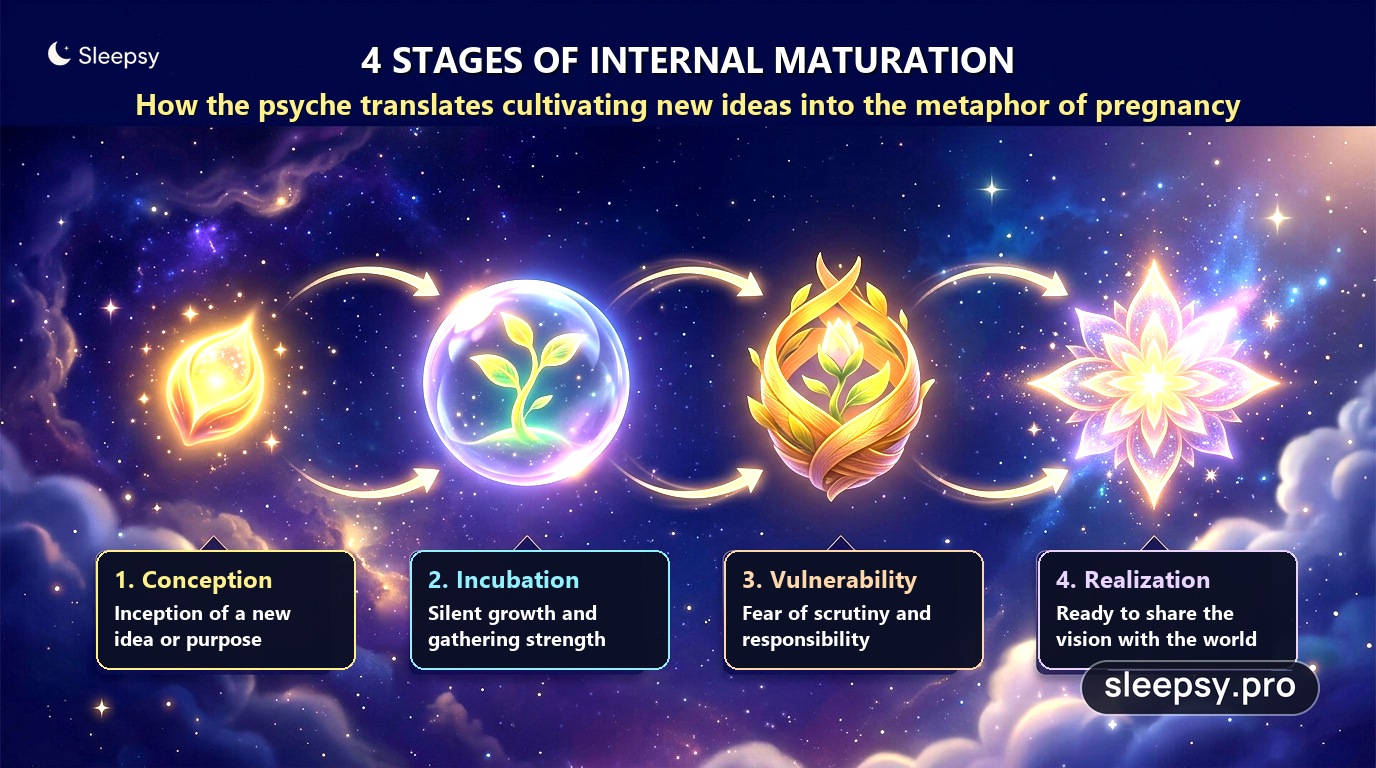
The specific manner in which the nocturnal plot unfolds points directly to the underlying emotional dilemma. In dream analysis, four distinct scenarios appear with remarkable frequency:
1. Conception of New Ideas: Silent Gestation in Solitude.
In this dream, an individual often gazes with tenderness and surprise at a rounded belly or feels subtle, gentle movements within. There is no panic—only quiet reverence for something unexpected: “Can this truly be part of my reality?”
In waking life, the psyche reaches for humanity’s oldest symbol of creation. If you are developing an independent business, contemplating a career shift, or preparing an essential conversation, the subconscious suggests the core idea has already rooted. Avoid broadcasting plans indiscriminately, as external skepticism can easily stifle early inspiration. The dream offers a reassuring reminder: allow your vision to gain strength in quiet dedication before presenting it to the world.
2. Fear of Responsibility and Imposter Anxiety.
A contrasting scenario involves discovering an advanced pregnancy that elicits immediate shame, vulnerability, and constriction. The dreamer frantically attempts to conceal their body beneath oversized garments, fearing discovery: “I am not ready; everyone will realize I cannot manage this.”
This narrative exposes acute daytime pressure surrounding high stakes: a major promotion, leading a new team, purchasing a home, or spearheading an ambitious project. Elevated nervous tension often triggers anxiety dreams and chronic stress. The sleeping mind amplifies worst-case fears, highlighting the weight of accountability. Yet apprehension before a significant step is completely natural. Ask yourself: are you daunted by the endeavor itself, or merely terrified of falling short of external expectations?
3. Parting with the Past: Identity Transition and Maturation.
Here, pregnancy is perceived as an established reality that irreversibly transforms the dreamer’s daily life. A subtle melancholy often permeates the dream: the individual sorts through former clothing, mourning the simplicity of past routines while stepping into unfamiliar territory.
This motif arises during pivotal life separations. You may be outgrowing an accommodating workplace persona, childhood family dynamics, or an unfulfilling relationship. The former role constricts you, yet the new identity remains incomplete. Pregnancy in this context symbolizes an irreversible threshold: the sleeping brain facilitates healthy grief over past ease while anchoring your readiness for autonomy and authentic authority.
4. Somatic Resonance, Hormones, and Physical Fatigue.
Not every nocturnal narrative represents an existential crossroads; many stem directly from physiological stimuli. Feelings of abdominal fullness, muscle cramps, digestive strain, or an uncomfortably warm room easily weave themselves into the dream fabric.
Luteal phase fluid retention, rigorous core workouts, or late dinners are frequently translated by the sleeping mind into an accessible physical parallel—pregnancy. Similarly, frantic searches for a medical professional or pharmacy in a dream often reflect somatic exhaustion. If you have been working without rest, this is your body’s urgent call to slow down, reduce external obligations, and prioritize restorative sleep.
Case Analysis: Why the Subconscious Hides the Belly
Consider a hypothetical scenario where an individual preparing to launch an ambitious creative project dreams of discovering an advanced pregnancy. Standing in front of a mirror surrounded by work materials, she gazes at her rounded reflection with tender pride.
Yet the moment visitors and colleagues enter the room, overwhelming panic sets in. She hastily grabs a heavy canvas work apron, tying the strings tightly across her midsection in an urgent attempt to conceal her condition from outside scrutiny.
In her waking life, starting a family was not on her horizon. For several months, however, she had been pouring her savings, late evenings, and creative energy into developing an independent educational masterclass. With registration set to open within days, anxiety had escalated dramatically.
“I spent months passionately perfecting this project, but now I feel frozen. If peers find out what I am doing, I worry they will think I am presumptuous and reaching beyond my station.”

The nocturnal drama cleanly mirrored her internal tug-of-war. The quiet joy before the mirror represented authentic devotion to her work. The frantic effort to conceal the belly beneath an apron reflected imposter anxiety and dread of critical judgment. Deconstructing this parallel through psychological analysis enabled her to release unnecessary shame and launch her initiative with composure.
The Neurobiology of Sleep: Why the Brain Chooses Pregnancy
The human brain rarely processes complex emotional transitions through abstract mathematical logic. When an important endeavor, career pivot, or geographic relocation looms, the psyche instinctively seeks a visceral, somatic representation. Pregnancy emerges as nature’s most compelling metaphor: something meaningful is forming within you, demanding energy, protective care, and time to develop.
During the night, subconscious networks synthesize waking concerns with ancient evolutionary symbols. To appreciate what dreams are made of and how neural networks encode daytime residue, think of the sleep state as a secure cognitive incubator designed to facilitate adaptation to change.
A comprehensive systematic review of nocturnal brain activity led by Serena Scarpelli demonstrates that dreams featuring bodily transformation and somatic evolution play a pivotal adaptive role, actively assisting the mind in processing daytime anxiety and preparing for radical life transitions.
The dream functions as an experiential rehearsal space. In safe nocturnal surroundings, the psyche tests the emotional weight of unfamiliar responsibilities, softening acute waking apprehension before real action is taken.
This protective mechanism aligns with landmark research on affective regulation during sleep by Tore Nielsen and Ross Levin, which demonstrates that navigating emotionally charged dream scenarios—where excitement and apprehension intertwine—enables the brain to discharge nervous strain, significantly reducing morning anxiety.
During REM sleep, emotional centers such as the amygdala remain highly engaged while the release of stress-inducing noradrenaline is suppressed. This neurochemical equilibrium allows the central nervous system to confront vulnerabilities safely and confirm that your inner endeavors are unfolding at their natural tempo.
Morning Reflection: 4 Questions Instead of a Dream Book
If you awaken after a vivid pregnancy dream, resist the temptation to browse unverified online forums. Pour a warm beverage, take a steady breath, and reflect on these four grounding questions:
- What was your predominant emotion upon waking? Was it creative inspiration, shame, relief, or bewilderment? The core emotional tone of the dream honestly reflects your underlying relationship to waking events.
- Which personal undertaking requires patience right now? A career transition, creative venture, difficult conversation, or relocation? Every meaningful milestone demands dedicated time to mature.
- Whose judgment do you fear the most? If you attempted to hide your condition in the dream, identify where in your waking life you feel vulnerable to external criticism.
- Are you giving yourself permission to grow without haste? Pulling on a seedling will not make it flourish faster. Grant your goals the grace of steady, unhurried cultivation.
Key Takeaways and Insights for Growth
Core landmarks for interpreting a pregnancy dream:
- Folklore vs Reality: Traditional dream books rely on superstitions or superficial omens. In cognitive psychology, a dream’s value lies entirely in your waking emotional context.
- Metaphor of Maturation: A pregnancy motif represents the inner development of meaningful ideas, creative ventures, or a new social role requiring patient incubation.
- Fear of Responsibility: Trying to conceal a rounded belly in a dream often mirrors waking imposter syndrome. It reflects the weight of an important step rather than personal inadequacy.
- Sleep Biology: During REM sleep, the brain acts as an emotional incubator: quieting stress hormones to help the nervous system adapt gently to change.
Key Takeaway: A dream about pregnancy encourages trust in your internal timeline. Allow your ideas and personal transitions to mature at their natural pace without demanding instant results.
To deepen your understanding of nocturnal metaphors and alleviate nighttime stress, record your reflections in the Sleepsy app. Our intelligent dream journal decodes complex dream patterns and restores restorative rest.