Every morning, millions of people wake up with the same bewildered question: what are dreams made of, and why do our sleeping minds assemble such surreal theatrical scripts? A single nocturnal storyline might juxtapose a childhood classroom, a passing phrase overheard at a coffee shop, and an exhilarating flight above a starlit ocean. On the surface, the nocturnal cinema appears woven from utter randomness. Yet modern cognitive neuroscience and somnology demonstrate precisely the opposite: dreaming possesses an elegant, three-tier architecture, and not a single image enters your nocturnal theater by chance.
When we fall asleep, cortical activity does not shut down. Instead, the central nervous system shifts into an intensive mode of memory consolidation, neural pruning, and affective recalibration. Rather than projecting prophetic riddles, the sleeping brain weaves together three distinct biological building blocks: recent sensory fragments, unprocessed emotional tension, and free generative associative synthesis. Understanding this triadic framework transforms dream recall from confusing folklore into an actionable window into mental well-being.
Day Residue: Where Dream Scenery Originates
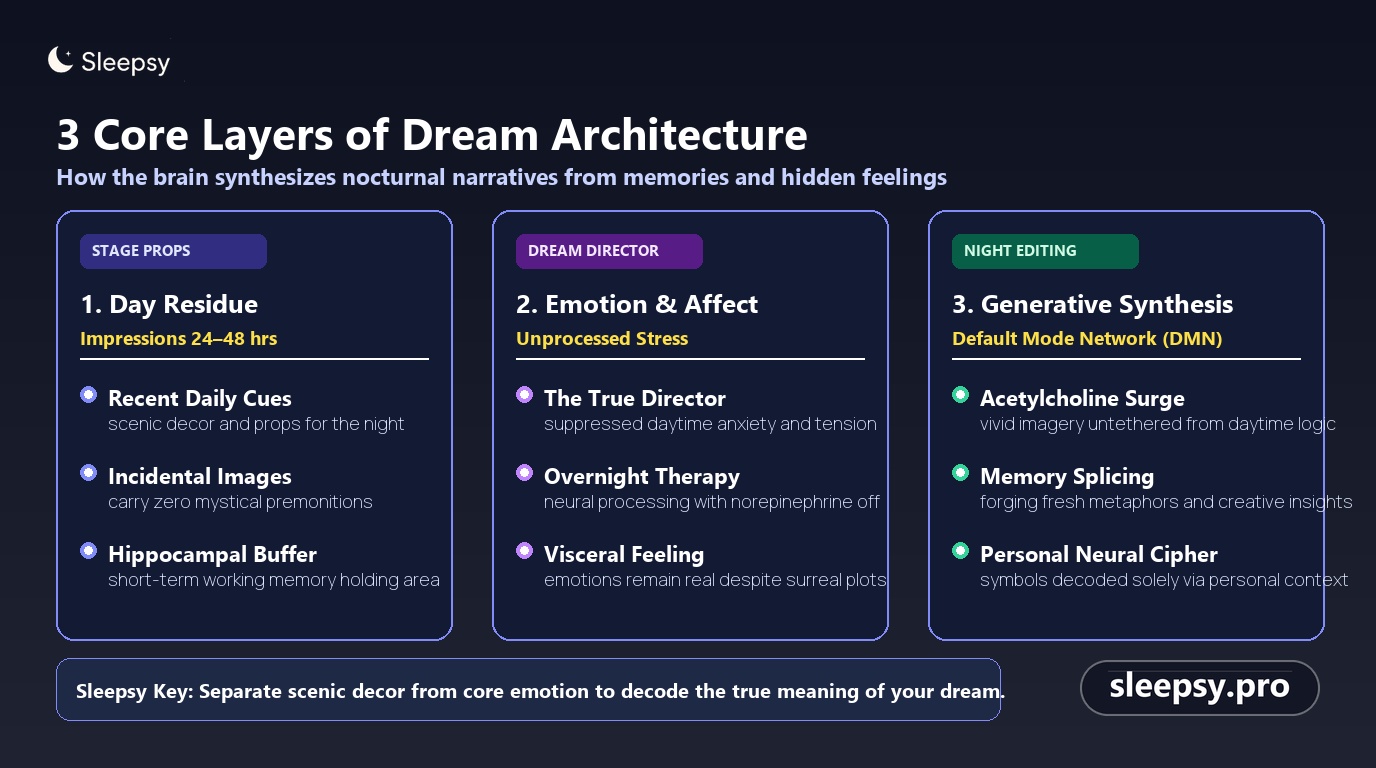
The first and most conspicuous stratum of any dream narrative is what psychoanalysis historically termed day residue (from Sigmund Freud's German concept Tagesreste), which modern functional neuroimaging has confirmed as temporary hippocampal trace activation. These are the sensory scraps, visual snapshots, stray words, and incidental encounters accumulated over the preceding 24 to 48 hours.
If you caught a momentary glimpse of a vintage red sports car in traffic, heard a strange song playing in an elevator, or spent four hours analyzing financial spreadsheets, these elements frequently infiltrate your nocturnal plots. The brain selects them not because they carry profound spiritual significance, but because they reside right at the surface of working memory in the hippocampus, waiting to be cleared or filed away.
Day residue provides merely the stage props and scenic backdrops of a dream. It is a cognitive fallacy to assume a dream is fundamentally "about" a red car. The vehicle is simply an accessible piece of visual paint borrowed by the neural network to stage a far deeper underlying emotional theme.
A landmark investigation led by Harvard neuroscientist Robert Stickgold vividly demonstrated this biological dynamic. In the study, participants played the video game Tetris for multiple hours before bedtime. During initial sleep-onset hypnagogia, over sixty percent of players reported vivid visual imagery of falling geometric tetromino blocks. Their brains were actively replaying fresh perceptual patterns to optimize procedural learning. Yet the emotional valence of each dream—whether the blocks felt playful, overwhelming, or suffocating—was dictated entirely by the individual's baseline emotional state rather than the digital game itself. When daytime stress remains unresolved, these sensory backdrops can even trigger intense anxiety dreams and stress.
The Dream-Lag Effect: Why Last Week’s Events Surface Tonight
Have you ever noticed a curious temporal disconnect: an emotionally charged conversation occurred on Monday, yet you do not dream about the person or topic until Sunday night? In experimental somnology, this temporal delay is known as the dream-lag effect.
Pioneering investigations conducted by Professor Mark Blagrove and colleagues at Swansea University established that the incorporation of autobiographical waking events into REM dreams follows a distinct, two-wave biological schedule:
- Immediate Wave (Days 1–2): The brain processes superficial sensory impressions from the waking day, rapidly filtering immediate environmental noise through fast-acting hippocampal circuitry.
- Delayed Wave (Days 5–7): Deep memory consolidation takes place as neural representations transfer from the temporary hippocampal buffer to long-term associative networks across the neocortex. During this second wave, the semantic and emotional meaning of an event resurfaces in dreams, stripped of literal details and recast into creative metaphors.
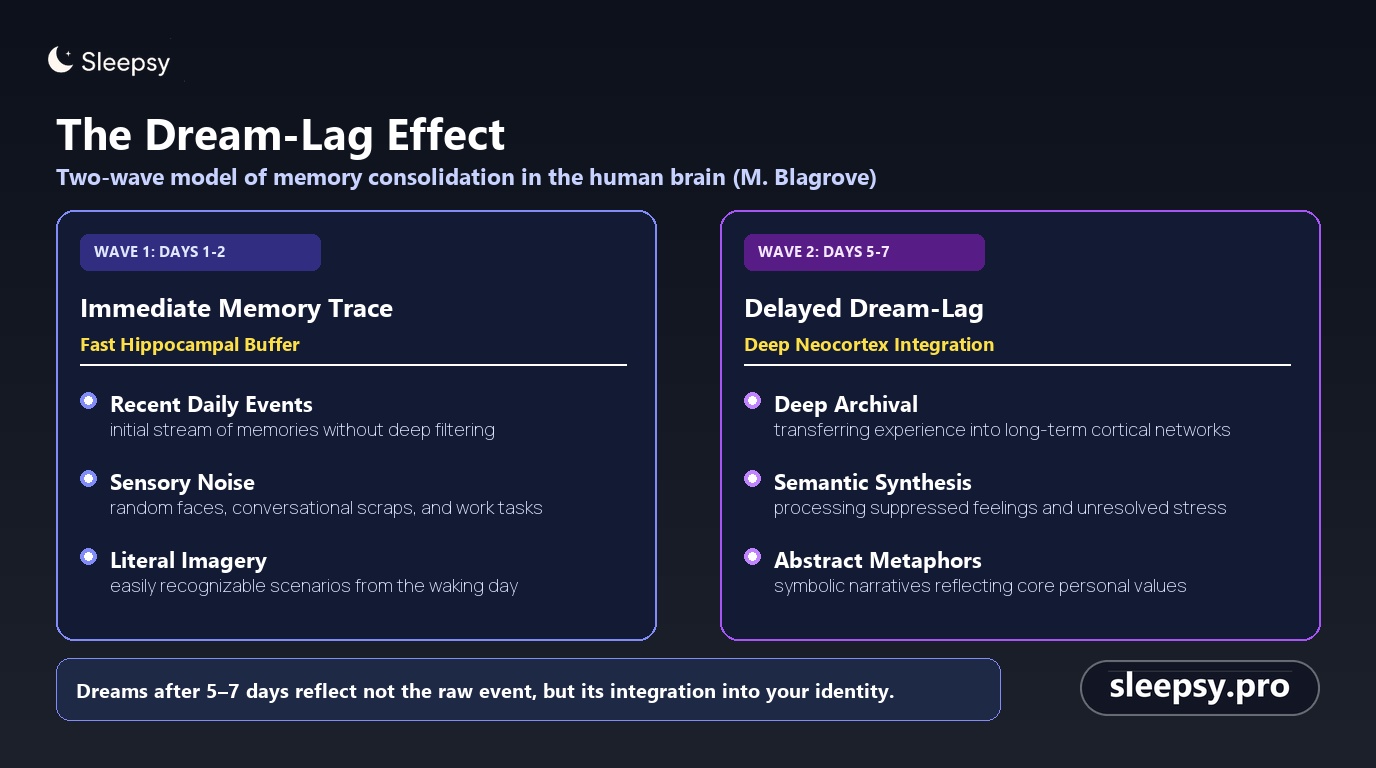
When a scene from five days ago unexpectedly emerges in your dream tonight, your brain is engaged in its second pass of archival integration. It is actively determining how that experience aligns with your broader self-concept, beliefs, and emotional coping mechanisms.
The Emotional Core: The True Director of Your Night Narrative
If day residue provides the physical scenery and props, who directs the production? The true dramatist behind every dream script is the emotional core—an unexpressed, suppressed, or unprocessed feeling carried over from your waking hours.
Throughout waking life, social decorum and conscious executive control require continuous emotional suppression. We maintain a polite smile before a demanding supervisor, swallow irritation in family dynamics, or dismiss sudden pangs of self-doubt. The prefrontal cortex rigorously regulates conscious expression. But during sleep—particularly in the Rapid Eye Movement phase—dorsolateral prefrontal inhibition subsides, granting unchecked primacy to the limbic system, with the amygdala firing at peak capacity.
Neurobiologist Matthew Walker at UC Berkeley conceptualized REM dreaming as "overnight therapy." During REM sleep, the brain reactivates emotionally salient experiences in an extraordinary neurochemical micro-environment: the stress neurochemical norepinephrine (noradrenaline) is completely switched off in the brainstem locus coeruleus. This neurochemical sanctuary allows cortical networks to reprocess stressful autobiographical memories without triggering the visceral panic of the fight-or-flight response, gently detaching painful emotional charge while consolidating the factual lesson.
The narrative storyline of a dream may read like surreal fiction, but the visceral emotion experienced inside the dream is always one hundred percent authentic. If a colossal shadow is pursuing you down a collapsing hallway, your mind is not warning you about physical monsters; it is processing your real-world sense of powerlessness or overwhelm in the face of an impending decision.
Recognizing that dreams speak the language of pure emotion frees us from unnecessary alarm. A distressing plotline does not foreshadow tragedy; it is an internal health check notifying you of unresolved psychological friction that requires compassionate daytime attention.
Generative Synthesis: The Neurochemistry of Nocturnal Cinema
The third fundamental pillar is generative synthesis: the brain's astonishing computational ability to weave disparate memory fragments into an immersive, multi-sensory cinematic narrative. This generative editing suite is powered by the Default Mode Network (DMN), a coordinated network of brain regions active during daydreaming, mind-wandering, and nocturnal REM states.
From a neurochemical perspective, REM dreaming represents a unique physiological phenomenon. While the brain is isolated from external sensory input, its internal neurochemical tides shift radically:
- Acetylcholine Surge: Levels of acetylcholine in the hippocampus and neocortex spike up to four times higher than during quiet wakefulness, stimulating visual cortex associations and generating vivid, dreamlike imagery.
- Aminergic Quenching: Serotonin and norepinephrine decline to negligible levels, temporarily releasing memory networks from linear, analytical logic.
This neurochemical cocktail explains why dreamers rarely question bizarre narrative turns while immersed in sleep. When a household cat begins quoting philosophy or an office hallway morphs into a sun-drenched meadow, the absence of prefrontal critical verification allows the mind to explore unconventional metaphorical solutions. For an exhaustive exploration of these biological sleep cycles, consult our guide to sleep architecture and REM phases.
Why Dream Dictionaries Fail: Universal Symbols vs. Personal Context
Upon waking from an unsettling dream, many people instinctively consult online dream books or traditional dream dictionaries to interpret specific symbols. Yet from a cognitive psychology standpoint, generic dream books represent an obsolete framework that imposes static dogmas on dynamic mental processes.
Traditional dream interpretation manuals presuppose a universal code: the erroneous belief that an object holds an identical meaning for every human being on Earth. In reality, human memory is organized as an idiosyncratic semantic web, where every symbol is wired to personal life history, emotional associations, and cultural background.
| Analytical Parameter | Generic Dream Books | Sleepsy Cognitive Framework |
|---|---|---|
| Symbol Interpretation | Rigid, universal dogmas (e.g., "water means tears; teeth mean loss") | Idiosyncratic, rooted in the individual's unique memories |
| Waking Life Context | Completely disregarded in favor of mystical archetypes | Directly anchored to recent stressors, changes, and milestones |
| Primary Analytical Focus | Superficial object catalogue ("key", "snake", "train") | Somatic emotion and visceral affect upon waking |
| Actionable Outcome | Fatalism, elevated anxiety, superstitious dread | Self-awareness, emotional relief, cognitive clarity |
Consider a simple dream object: a dog. For a veterinary professional or animal lover, a dog appearing in a dream may evoke comfort, unconditional loyalty, and warmth. For someone who survived a severe canine attack in early childhood, the very same animal represents terrifying threat and helplessness. No pre-printed dictionary can account for these divergent associative matrices. When subconscious themes recur without resolution, they often crystallize into recurring dreams that demand personalized introspection.

Practical Framework: 4 Steps to Decode Your Dreams Without Superstition
To extract meaningful insights from nocturnal narratives without falling into unscientific folklore, sleep psychologists utilize a systematic, four-stage protocol.
- Filter Out the Day Residue: Catalogue all familiar objects, locations, and acquaintances appearing in the dream. Ask yourself: "Where did I encounter these sensory cues over the past 48 hours?" If you watched a wildlife documentary before bed, the mountain landscape in your dream is simply scenic wallpaper. Discard it from deeper symbolic inquiry.
- Isolate the Core Emotional Climax: Pinpoint the predominant emotional state experienced at the peak of the narrative. Was it abandonment, exhilaration, humiliation, or relief? Identify this visceral sensation with precision. The emotion experienced represents the authentic foundation of the dream.
- Map Personal Associative Chains: Select the most vivid or unusual metaphor in the dream. Suspend rigid logic and ask: "What does this image spontaneously bring to mind in my current life? What does it feel like?" The initial unprompted association frequently unlocks the underlying meaning.
- Connect the Metaphor to Waking Reality: Where in your present waking life are you encountering a comparable psychological state? A dream featuring a malfunctioning steering wheel rarely concerns automotive safety; rather, it reflects a subjective sensation of losing control over a professional project or interpersonal relationship.
Because dream memories fade rapidly within minutes of morning arousal, capturing these subtle associations requires consistent habit. Review our comprehensive blueprint on how to keep a dream journal to systematically preserve your morning recollections before they dissipate.
Key Takeaways
Dreaming is neither meaningless neural static nor an arcane fortune-telling mechanism. It represents an evolved biological apparatus for emotional regulation and cognitive integration.
- Dream Architecture Is Tripartite: Day residue supplies the physical decor, the emotional core provides the narrative drive, and generative synthesis weaves the disparate fragments into a cohesive story.
- The Dream-Lag Delay: Thanks to the two-wave memory consolidation model, deeper psychological processing often manifests in dreams with a 5- to 7-day delay.
- Dream Books Are Ineffective: Universal symbol keys fail because dream imagery is shaped entirely by an individual's personal associative networks.
- Emotions Are the Ground Truth: While nocturnal storylines can be wildly surreal, the feelings experienced within them reflect authentic daytime concerns.
Bottom Line: Rather than searching for omens in your dreams, look inward at your present reality. Your dreams do not foretell what is coming tomorrow; they honestly reflect what you have not yet allowed yourself to confront in the light of day.
By learning to read these nocturnal signals with scientific curiosity, you turn confusion into self-awareness. Whether you are navigating high-stress transitions or simply seeking deeper mental clarity, exploring your personalized dream analysis through Sleepsy provides an evidence-based roadmap to decode your mind and wake up with profound clarity every morning.