«I woke up in a cold sweat after dreaming of a green snake coiled right by my hand. Does this guarantee betrayal from someone close to me?»
Queries like this flood sleep inquiry boards every morning. People rush to search traditional dream encyclopedias, which immediately threaten them with deceitful rivals, catastrophic backstabbing, or looming misfortune.
The immediate impulse following such a vivid nightmare is to look around with sudden paranoia, scanning colleagues and friends for hidden hostility.
For centuries, cultural folklore conditioned us to treat the snake as an omen of malicious external enemies. Yet blindly relying on archaic superstitions replaces genuine psychological insight with baseless anxiety.
A dream about a snake is an honest dialogue between the brain and itself.
Far from predicting mystical betrayals, the serpent serves as an ancient symbol of subconscious threat detection and boundary vigilance. It signals that your perceptual system has detected subtle inconsistencies or boundary erosions in waking life that your conscious mind chose to brush aside.
What Traditional Dream Books Say: Miller, Vanga, Freud, and Jung
When searching for answers online, readers encounter a bewildering clash of contradictory predictions.

Historical commentators viewed the serpent through the distinct cultural anxieties and conceptual limitations of their eras:
- Gustavus Hindman Miller: Regarded snake dreams as severe warnings of impending malice. Miller asserted that venomous snakes represent hostile rivals actively plotting sabotage. Being bitten by a serpent in Miller's system forecasted surrender to wicked schemes and reputational damage.
- Folkloric and Mystic Traditions: Viewed the snake as an omen of treachery, envy, and domestic discord. Many folklore manuals insist that seeing a nest of snakes indicates being surrounded by disloyal acquaintances, while killing a snake signifies hard-won victory over competitors.
- Sigmund Freud: Framed the serpent within repressed psychosexual dynamics. In classical psychoanalysis, the snake operates as a phallic emblem, reflecting repressed sexual tension, subconscious taboos, or anxieties surrounding intimacy and bodily vulnerability.
- Carl Gustav Jung: Elevated the serpent from a mere warning of deceit to a profound archetype of the collective unconscious. Jung linked the snake to the serpent of healing (Asclepius) and the Ouroboros, interpreting it as an emblem of instinctive wisdom, visceral vitality, and psychological renewal.
Why Superstitions Mislead: Context Dictates Meaning
Notice the extreme divergence in traditional interpretations: from catastrophic deceit to sexual anxiety and spiritual rebirth. When predictions contradict each other so drastically, taking them literally is counterproductive.
Universal dream dictionaries fail because they impose rigid medieval templates onto unique human lives. A dream symbol is meaningless without your personal emotional context and waking realities.
Consider two contrasting waking situations:
A professional facing mounting workplace burnout dreams of a hissing snake. For them, this imagery represents unspoken resentment toward predatory deadlines and uncompensated overtime.
Meanwhile, an artist embarking on a daring creative project dreams of a calm, shimmering serpent shedding its skin. In this case, the image reflects an exciting personal transformation and shedding obsolete fears.
Identical archetype. Two completely different psychological realities.
At Sleepsy, we dismiss supernatural fortune-telling. We analyze how nocturnal metaphors map directly onto your real emotional life, helping you hear what your subconscious is actually communicating.
| Nocturnal Scenario | Traditional Dream Books | Sleepsy Psychological Perspective |
|---|---|---|
| Sharp snake bite on hand or leg | Devastating betrayal or financial blow | Acute violation of personal boundaries and waking emotional pain |
| Coiled nest of hissing snakes | Vicious slander and surrounding enemies | Chronic social tension, toxic dynamics, and passive manipulation |
| Snake shedding dry skin peacefully | Sudden inheritance or illness recovery | Inner growth, emotional shedding of outdated patterns, and renewal |
| Snake quietly gliding past on a path | A secret danger avoided by sheer luck | Awakening intuition urging heightened mindfulness and discernment |
Dreaming of a Snake: 4 Psychological Scenarios
Consciousness typically remembers only the dramatic surface imagery.
In analytical psychology and evolutionary biology, however, the serpent embodies visceral threat assessment and instinctual wisdom. The sleeping brain summons this primal metaphor when waking cognitive filters struggle to articulate an uncomfortable reality.
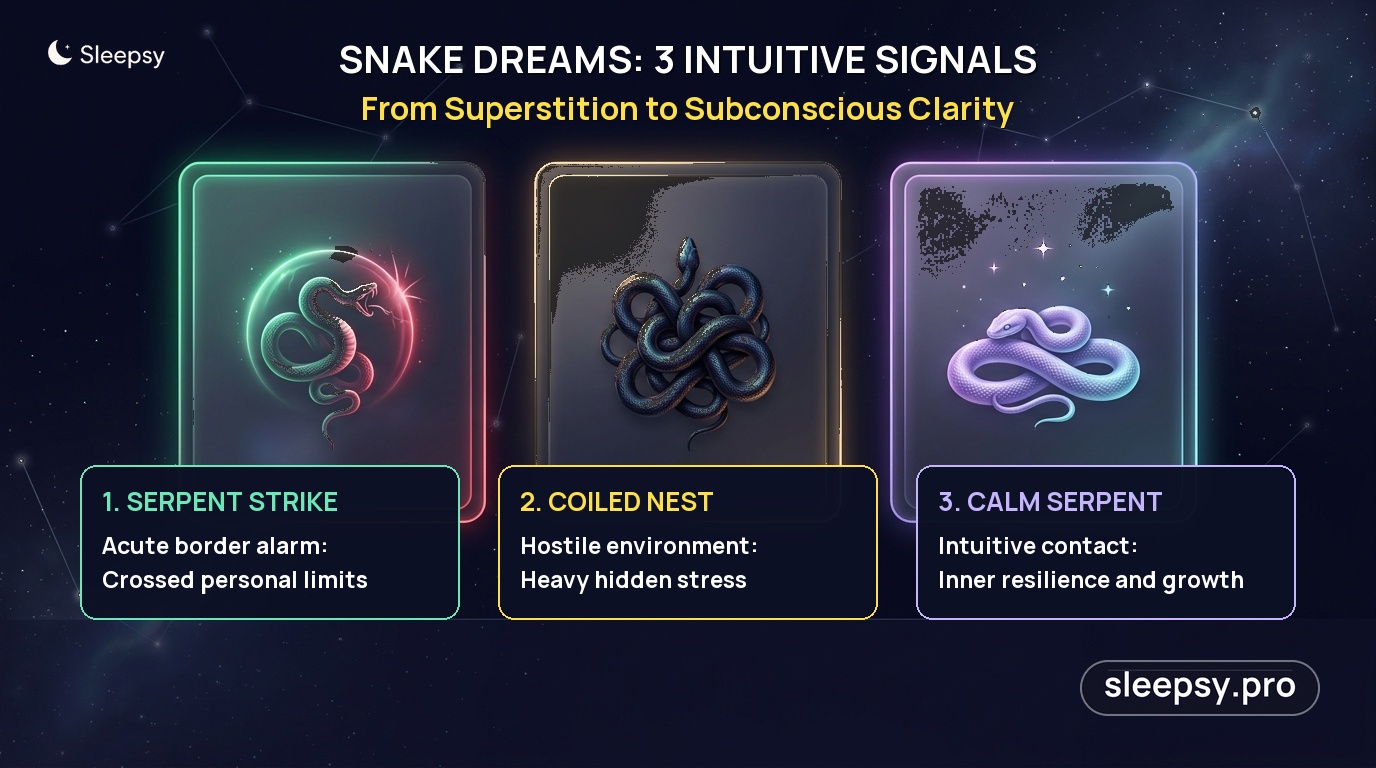
Different dream dynamics highlight distinct subconscious focal points:
1. A sudden snake bite: acute violation of personal boundaries.
A dream where a snake strikes without warning, sinking its fangs into your hand, leg, or neck, leaves a visceral ache upon awakening. In analytical practice, this image points directly to a punctured psychological boundary. You may be tolerating invasive questions, accepting passive disrespect, or accommodating someone else's agenda at the expense of your own integrity.
The sleeping brain registers this dynamic not merely as an inconvenience, but as an acute toxic puncture. The bite serves as an urgent wake-up call: where in your waking life are you currently letting down your defenses?
2. A tangled nest of hissing serpents: toxic group dynamics.
Finding yourself standing before a pit or nest of squirming, hissing snakes evokes intense revulsion and helplessness. This dream reflects an overwhelming environment where passive aggression, duplicity, or covert hostility permeate the social atmosphere. Such dreams frequently arise in tense office environments or strained family gatherings.
Your rational mind might dismiss subtle sarcastic remarks as harmless banter. But your subconscious detects the underlying friction, warning you that prolonged immersion in this environment is draining your vitality.
3. A snake peacefully gliding along a path: watchful intuition.
Observing a serpent resting quietly in grass or sliding across a forest path without aggression elicits respect rather than panic. This narrative reflects healthy vigilance. Your subconscious is tracking a potential risk in a business transaction, romance, or investment, urging you to proceed with calculated care.
The dream does not command you to turn back in fear. Instead, it invites you to slow down, verify details, and honor your intuitive hesitation.
4. A calm serpent shedding its skin: inner transformation.
When a snake glides serenely through sunlight or effortlessly sheds its worn, dry skin, waking up brings an unusual feeling of clarity and relief. In Jungian psychology, this symbolizes deep healing, renewal, and individuation. The psyche has digested a difficult transition and is shedding outgrown behaviors.
On waking, you may be ready to let go of people-pleasing, outdated self-doubt, or obsolete obligations. The dream confirms that you possess the inner resources required for this evolution.
A Work Environment Case Study: The Emerald Serpent
Consider a hypothetical scenario in a demanding corporate healthcare setting. A dedicated veterinary surgeon consistently absorbs extra weekend shifts and tedious administrative burdens on behalf of an older colleague. "You are younger and need the hands-on exposure," the senior colleague smiles politely. Fearing interpersonal friction and wanting to be seen as collaborative, the professional quietly accepts the grueling load, working late into the night and suffering from chronic exhaustion.

Eventually, a vivid nocturnal nightmare occurs. In the quiet examination room under sterile fluorescent light, a slender emerald-green snake lies resting across patient files and medical instruments. It slides soundlessly across the paperwork, wrapping itself in a cool, tightening band around the clinician's wrist and emitting a warning hiss whenever they reach toward diagnostic tools. The dreamer awakens frozen in dread.
«Upon reflection, the quiet hiss of the serpent perfectly mirrored the polite yet paralyzing undertone of the colleague's requests. The fear of confrontation had completely compromised professional boundaries».
This dream had nothing to do with supernatural prophecies of doom.
The image of the emerald serpent operated as an unflinching mirror of passive aggression that the conscious mind struggled to confront. Once the metaphorical signal was acknowledged, the professional calmly declined unnecessary overtime shifts and established firm operational hours.
The covert manipulation subsided, and with it, the recurring nocturnal nightmares disappeared.
The Neuroscience of REM Sleep: Why the Brain Selects the Serpent
Why does the subconscious mind gravitate toward serpent imagery with such enduring consistency across cultures?
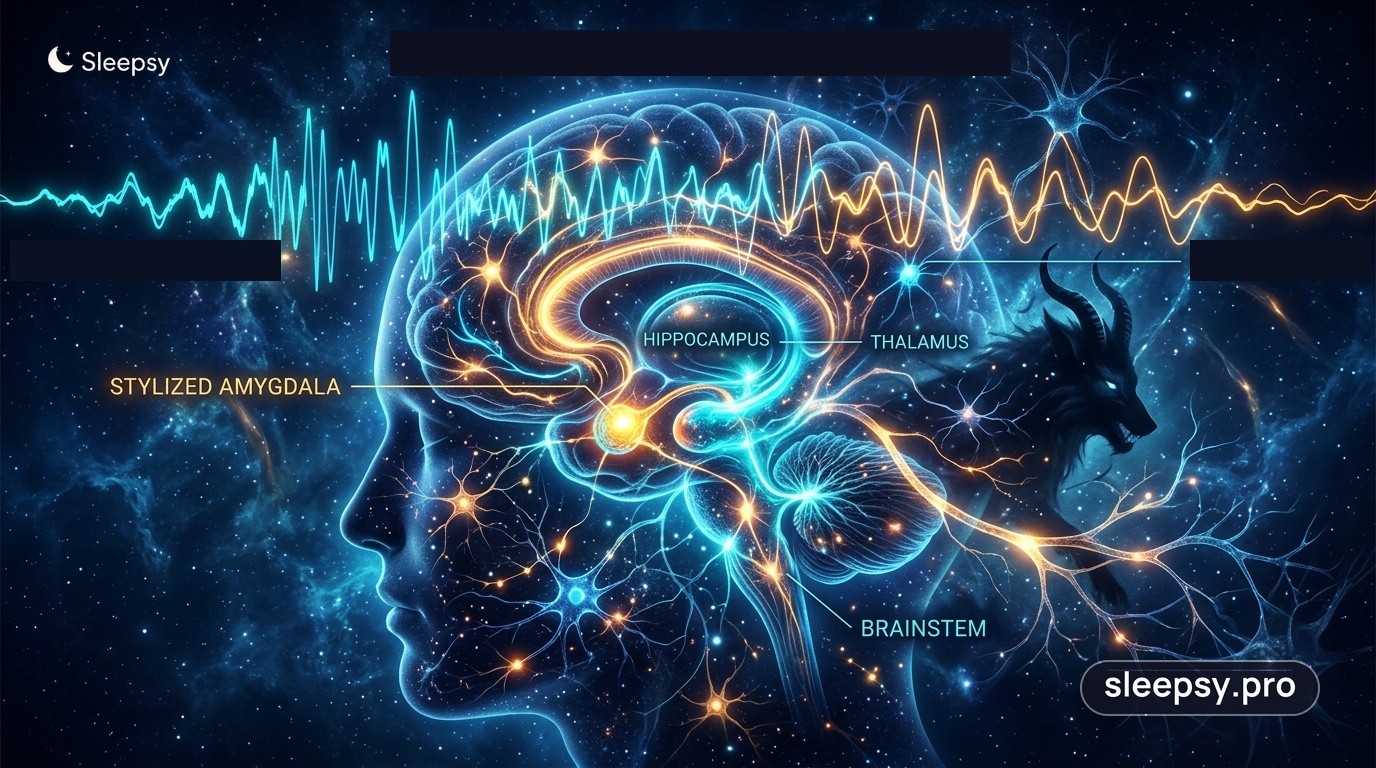
During daylight hours, conscious attention is heavily filtered by the prefrontal cortex to prioritize immediate cognitive tasks. We routinely overlook micro-expressions of contempt, insincere praise, or subtle somatic discomfort, telling ourselves not to overreact. Yet the amygdala and subconscious sensory circuits capture these subtle discrepancies.
During rapid eye movement (REM) sleep, the brain consolidates emotional memories and recalibrates defensive reflexes.
In landmark empirical research on the evolutionary functions of dreaming led by Antti Revonsuo, findings established that REM sleep consciousness simulates ancestral survival threats to safely rehearse threat-avoidance behaviors. The human brain possesses genetically hardwired neural pathways specialized for the instantaneous detection of serpents and predators, making this archetypal figure a natural vehicle for modeling covert social hazards.
The snake in your dream is an evolutionary template. It provides a visual shorthand for situations requiring heightened vigilance.
Furthermore, clinical research examining symbolic representations demonstrates that serpent symbolism activates and restores visceral vitality while facilitating the integration of previously suppressed emotional states. Confronting and decoding the warning messages carried by the serpent allows subconscious dread to transform into grounded resilience and self-assertion.
When you decode the biological and psychological purpose of the dream, fear dissolves into practical waking clarity.
Morning Boundary Audit: 4 Grounded Steps
If you recently awoke from a dream involving snakes, refrain from searching speculative forums. Conduct a mindful internal audit to examine where your waking life requires boundary reinforcement:

1. Note the snake's behavior and coloration.
Did the snake strike aggressively, remain dormant, or peacefully shed its skin? A venomous strike highlights an active emotional wound, while a dormant snake reminds you to stay observant in upcoming negotiations.
2. Examine bodily sensations upon waking.
Where did the dream leave tension in your physical body? Tightness in the throat points to withheld boundaries and unsaid truths. A knot in the solar plexus or chest suggests suppressed resentment and nervous exhaustion.
3. Identify the waking boundary breach.
Ask yourself honestly: in what area of my life am I agreeing to demands that deplete me? Which relationship leaves me feeling emotionally drained, second-guessed, or subtly manipulated?
4. Implement one concrete boundary action.
Subconscious insights require real-world grounding. Cancel an optional commitment that drains your energy, decline an unreasonable favor with calm brevity, or establish explicit expectations with colleagues.
Key Takeaways and Practical Insights
Dreaming of snakes is not an omen of misfortune, but a compelling invitation to align with your inner compass:
- Folklore vs. Reality: Traditional claims of supernatural betrayal miss the mark; modern neuroscience recognizes the serpent as a biological warning mechanism.
- Boundary Diagnostics: The posture and aggression of the snake mirror whether your waking boundaries are intact, challenged, or severely compromised.
- Threat Simulation Network: REM sleep simulates primal archetypes to help you recognize covert interpersonal friction and protect your psychological well-being.
- Constructive Action: A structured morning reflection transforms nocturnal dread into clear, decisive boundary enforcement in daily life.
Core Takeaway: A snake in your dream does not forecast doom. It signals that your intuition is wide awake, urging you to safeguard your personal space and trust your gut instincts.