Have you ever woken before the alarm, heart racing, and run your tongue along your gums to make sure your teeth are still there? In the dream, your incisors crumbled into sand, loosened, or dropped into your palm. The fear clings to you long after sunrise, and your first impulse is to search a dream dictionary for an omen of illness or loss. Take a breath. Modern sleep psychology reads this recurring nightmare differently: the brain may be translating jaw tension and unprocessed anxiety into one of its most vivid body metaphors.
Why teeth dreams feel so frightening
Dreams about losing or breaking teeth are among the most common and emotionally intense dream themes. You wake up relieved to find your mouth intact, yet the emotional residue can follow you through the day.
Traditional folklore often links damaged teeth with illness, bereavement, or an irreversible misfortune. Those predictions can create a feedback loop: daytime worry increases muscle tension, the jaw clenches more at night, and the same nightmare returns with even greater force.
A dream dictionary isolates a symbol from the person who dreamed it. At Sleepsy, we look at the whole system: what your body was doing overnight, what tension accumulated during the day, and where you felt your inner stability slip.
What traditional dream books get wrong
Look at the classic interpretations side by side and the problem becomes clear. Each system assigns the same image a different universal meaning:
- Gustavus Miller: a lost tooth may signal wounded pride, failed plans, illness, or trouble with adversaries.
- Vanga: the image is tied to grief, loss of authority, and severe emotional upheaval; a tooth with blood is traditionally linked to fear around family bonds.
- Sigmund Freud: the broken tooth becomes a symbol of exposure, guilt, threatened attractiveness, or anxiety about instinct and self-control.
- David Loff: the dream points toward social embarrassment, fear of losing face, and painful helplessness in front of other people.
One author sees a financial collapse, another a prophecy, a third an intimate conflict, and a fourth a public humiliation. These systems argue because they try to force a dead template onto a living nervous system. The personal context is the missing variable.
How bruxism becomes a teeth nightmare
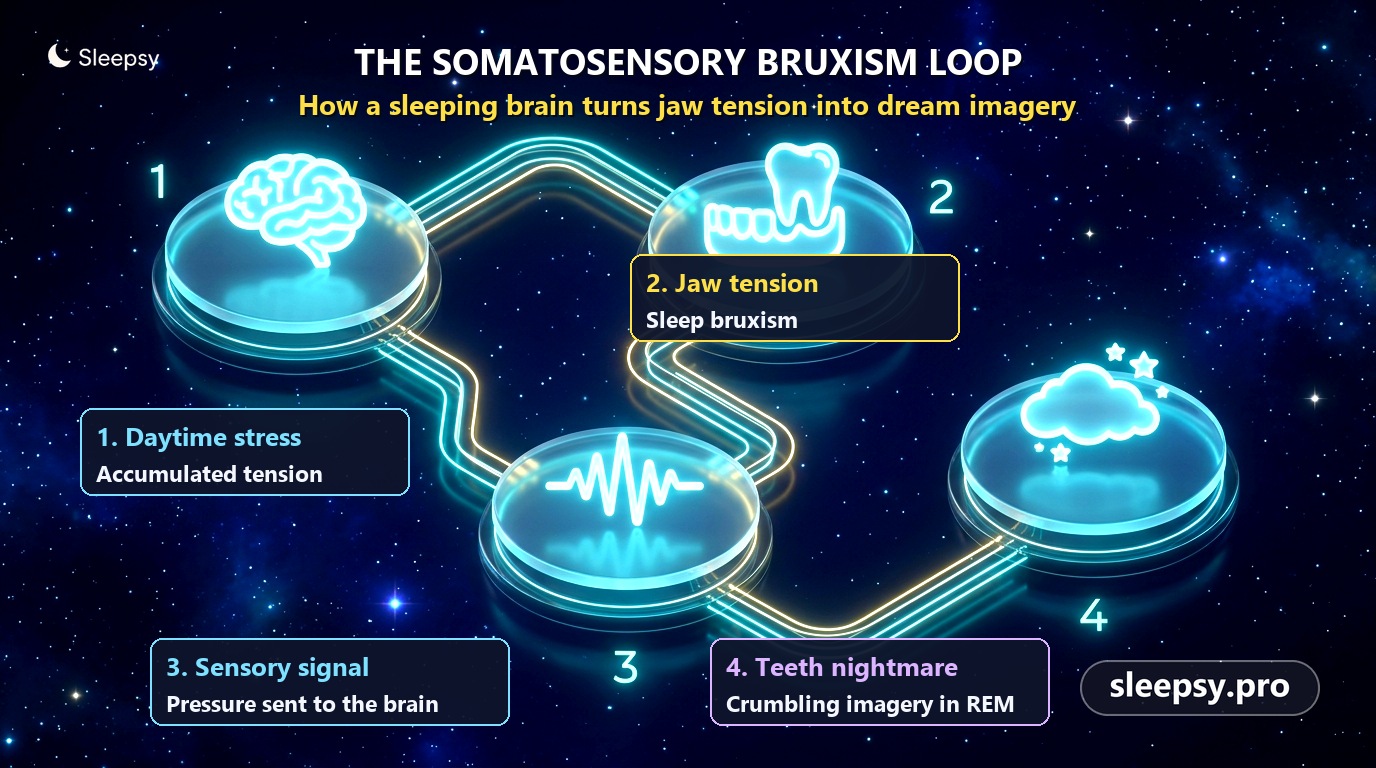
The physiological clue is somatosensory incorporation: the sleeping brain can weave real signals from the body into the story of a dream.
A study by Naama Rozen and Nirit Soffer-Dudek found that teeth dreams were associated with physical irritation or tension in the teeth, gums, and jaw upon waking, rather than with general psychological distress (Frontiers in Psychology, 2018).
A 2020 systematic review and meta-analysis found an association between stress and bruxism, while also noting that the certainty of the evidence was low and that better-standardized studies are still needed (Frontiers in Neurology, 2020).
During sleep, the jaw can still clench even when conscious control is offline. The tissues around the teeth send the brain a blunt message: “There is too much pressure here.” The sleeping mind does not narrate that signal as a dental symptom. Instead, it reaches for a visual explanation: crowns crack, enamel splinters, and teeth dissolve into grit.
The emotional layer: control and helplessness
Physiology may supply the raw signal, but waking emotion helps shape the plot. Why does the jaw tighten now, in this particular period of life?
Teeth are ancient tools of defence, status, and boundary-setting: showing your teeth, baring them, biting back. Losing them in a dream can feel like being stripped of the ability to protect a project, defend a boundary, or say a firm no when something is not acceptable.
Another common trigger is restrained anger. When someone has to stay polite at work or at home, swallow irritation, and force words through a clenched smile, the jaw may remain braced long after the conversation ends. At night, that tension can surface as grinding or clenching. If a dream keeps returning in the same form, our guide to recurring dreams and emotional loops offers a useful next question: what waking conflict has not found an outlet?
A dream of crumbling teeth is not a verdict about your future. It can be the nervous system’s blunt request to stop holding an impossible amount of control in your jaw, your body, and your day.
A hypothetical bridge-engineer scenario
Consider a hypothetical scenario. Someone responsible for a major bridge project repeatedly dreams of standing before an inspection panel. They try to defend the calculations, but the jaw locks, teeth crack like thin ice, and sharp fragments collect in their hand.
In waking life, the contractor has delivered defective steel, the deadline is closing in, and management is pressuring them to overlook deviations. During the day, anger is contained inside endless negotiations. At night, the brain stages the conflict physically: the structure is failing, the voice cannot get through, and the teeth become the place where pressure breaks apart.

A dental examination in this scenario might reveal fresh enamel chips and overworked jaw muscles. Once the person stops carrying sole responsibility for another party’s mistake and formally escalates the problem, the emotional fuel of the nightmare changes. The dream is not predicting a bridge collapse; it is showing where responsibility, anger, and bodily tension have become fused.
Morning signals and an evening reset
If the dream keeps returning, check for physical clues when you wake:
- Heaviness, stiffness, or a dull ache in the temples and cheek muscles.
- Clicking or discomfort in the jaw joint during the first yawn or bite.
- Tooth marks along the sides of the tongue or a pale line on the inside of the cheeks.
- Morning exhaustion that feels out of proportion to the hours you spent in bed. Our article on anxiety dreams and chronic stress explains how nocturnal tension can erode recovery.
To help the jaw release before sleep, try four simple steps:
- Notice daytime contact: your upper and lower teeth should normally touch for chewing and swallowing, not remain pressed together. Let a small gap return whenever you notice clenching.
- Find a relaxed tongue position: rest the tip of the tongue gently on the palate behind the upper front teeth, keep the lips soft, and allow the teeth to separate.
- Use warmth and gentle massage: before bed, place a warm towel over the cheeks and massage the muscles beneath the cheekbones without forcing the joint.
- Ask a dentist about protection: if there is visible wear, pain, sensitivity, or repeated jaw tension, a dental professional can assess whether an individual night guard or another treatment is appropriate.
Key takeaways
- Teeth dreams are not mystical warnings or guaranteed predictions of loss.
- Physical irritation and sleep bruxism may help turn jaw sensations into dramatic dream imagery.
- The emotional layer often involves loss of control, restrained anger, or the fear of being unable to act.
- Morning jaw pain, tooth sensitivity, chips, or persistent fatigue deserve attention from a dentist or other qualified healthcare professional.
Bottom line: a nightmare about crumbling teeth is not a sentence from fate. It may be your mind asking for less pressure, a clearer boundary, and a body allowed to rest.
Dreams are subtle maps of inner experience. If you want to track recurring signals without superstition, explore personalized dream analysis through Sleepsy and connect the night’s imagery with the life you are living by day.